Interview Questions to Ask Candidates: A Structured Approach That Actually Predicts Success
Choosing the right interview questions to ask candidates is the difference between a good hire and a bad one. Generic questions produce generic answers. Structured, criteria-based questions reveal whether a candidate can actually do the job.
Why Most Interview Questions to Ask Candidates Miss the Mark
The majority of interview questions asked in recruitment today have little to no predictive validity. Questions like "Where do you see yourself in five years?" or "What is your greatest weakness?" have been studied extensively, and the research is clear: they tell you almost nothing about whether a candidate will succeed in the role. They measure interview performance, not job performance. They reward preparation and presentation skills while failing to assess the actual competencies the role requires.
The problem is not that interviewers are unskilled. The problem is that crafting genuinely predictive interview questions requires significant preparation time that most hiring managers simply do not have. A well-constructed behavioural question targets a specific competency, creates a scenario that reveals relevant experience, and opens natural follow-up paths that probe depth. Building a full set of these for every role, for every candidate, is time-intensive work that typically gets skipped in favour of improvisation.
This is where structured approaches - whether manual frameworks or AI-generated question sets - fundamentally change interview quality. When every question serves a clear evaluative purpose and targets a defined criterion, interviews become assessment tools rather than conversations.
The Best Interview Questions to Ask Candidates: Competency-Based Approach
The most effective interview questions to ask candidates are those tied directly to the competencies the role requires. Rather than asking about abstract strengths or hypothetical situations, competency-based questions ask candidates to describe specific past experiences that demonstrate the capability you need. The premise is straightforward: past behaviour in relevant situations is the strongest predictor of future behaviour in similar situations.
For a role requiring stakeholder management, a strong question might be: "Tell me about a time you needed to influence a decision-maker who initially disagreed with your recommendation. What was the situation, what approach did you take, and what was the outcome?" This question targets a specific competency, requires a concrete example, and naturally invites follow-up about what they learned or would do differently. Compare this to "Are you good with stakeholders?" which produces only self-assessment rather than evidence.
For technical roles, competency questions shift toward problem-solving demonstrations: "Describe a technical challenge you encountered where your first approach failed. How did you diagnose the issue, what alternatives did you consider, and how did you arrive at the solution?" This reveals not just technical knowledge but problem-solving methodology, resilience, and learning orientation - all predictive of performance in complex roles.
50 Example Interview Questions to Ask Candidates, by Competency
Use the library below as a starting point. These are strong, evidence-seeking questions grouped by the competency they assess. Pick the ones that map to the criteria your role actually requires, then tailor the wording to the candidate in front of you. Every question is designed to prompt a specific example rather than a rehearsed answer, and each opens natural follow-up paths.
Behavioural & competency questions
- Tell me about a time you had to influence a decision-maker who initially disagreed with your recommendation. What did you do, and what was the outcome?
- Describe a situation where you had to deliver a project under significant time pressure. How did you prioritise?
- Give me an example of a goal you failed to meet. What happened, and what did you learn?
- Tell me about a time you had to resolve a conflict within your team.
Technical & problem-solving questions
- Describe a technical challenge where your first approach failed. How did you diagnose the issue and arrive at a solution?
- Walk me through how you would design a solution for [role-specific scenario], and what trade-offs you would weigh.
- Tell me about the most complex problem you have solved in this domain. What made it hard?
- How do you keep your skills current as tools and best practices change?
Leadership & teamwork questions
- Tell me about a time you led a cross-functional team. How did you keep everyone aligned?
- Describe how you have given difficult feedback to a colleague or direct report.
- Give an example of a decision you made that was unpopular with your team. How did you handle it?
- How do you support the development of the people who report to you?
Ethics & judgement questions
- Tell me about a time you faced an ethical dilemma at work. How did you decide what to do?
- Describe a situation where you had to choose between meeting a target and doing the right thing.
- Have you ever disagreed with a company policy or instruction? What did you do?
- How do you handle a situation where you spot a mistake that no one else has noticed?
Motivation & culture-fit questions
- What attracted you to this role specifically, rather than a similar one elsewhere?
- Describe the kind of work environment where you do your best work.
- Tell me about a time your values were tested at work.
- What does success in the first 90 days of this role look like to you?
The Power of Follow-Up Questions
A single question, no matter how well-constructed, only opens a door. The real insight comes from follow-up questions that probe deeper based on the candidate's response. Strong follow-ups prevent candidates from delivering rehearsed answers and reveal the depth of their actual experience versus surface-level familiarity.
Effective follow-up patterns include asking about scale ("How many people were affected by that decision?"), asking about alternatives ("What other approaches did you consider and why did you reject them?"), asking about learning ("What would you do differently if you faced that situation again?"), and asking about specifics ("Walk me through exactly what you did on day one of that project"). Each of these probes a different dimension of the candidate's experience and thinking.
The challenge for most interviewers is generating these follow-ups in real-time while also actively listening to the candidate's response. This is where preparation becomes critical - having suggested follow-up paths before the interview begins means the interviewer can focus on listening rather than simultaneously planning their next question.
How AI Tools Generate Better Questions
Knowing the right interview questions to ask candidates has always required preparation that most hiring managers lack time for. AI-powered interview question generation represents a fundamental shift in that preparation. Rather than starting from a blank page or recycling questions from previous roles, AI tools like GoVerse generate questions that are specifically tailored to the criteria defined for the role and calibrated to the individual candidate's profile.
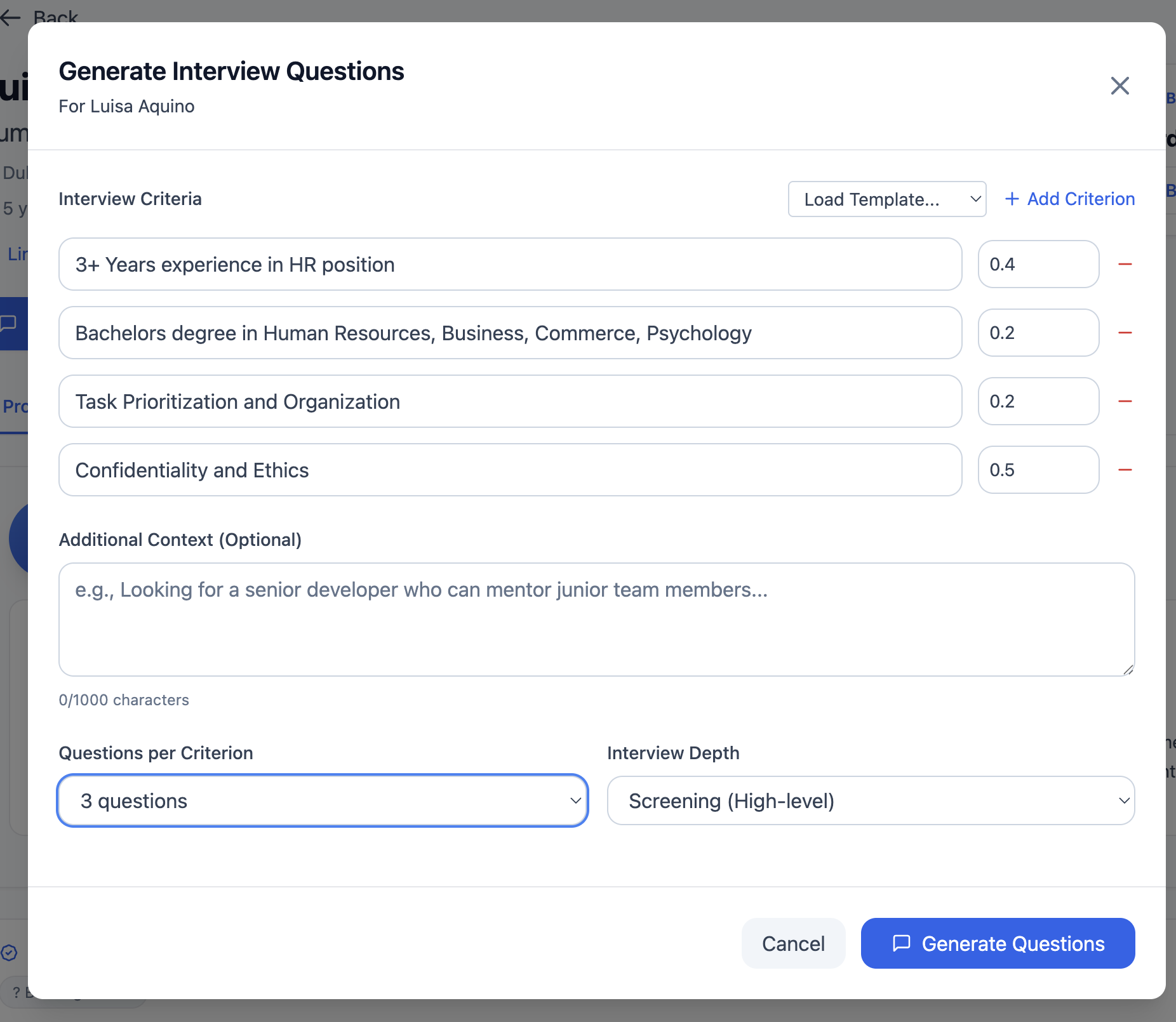
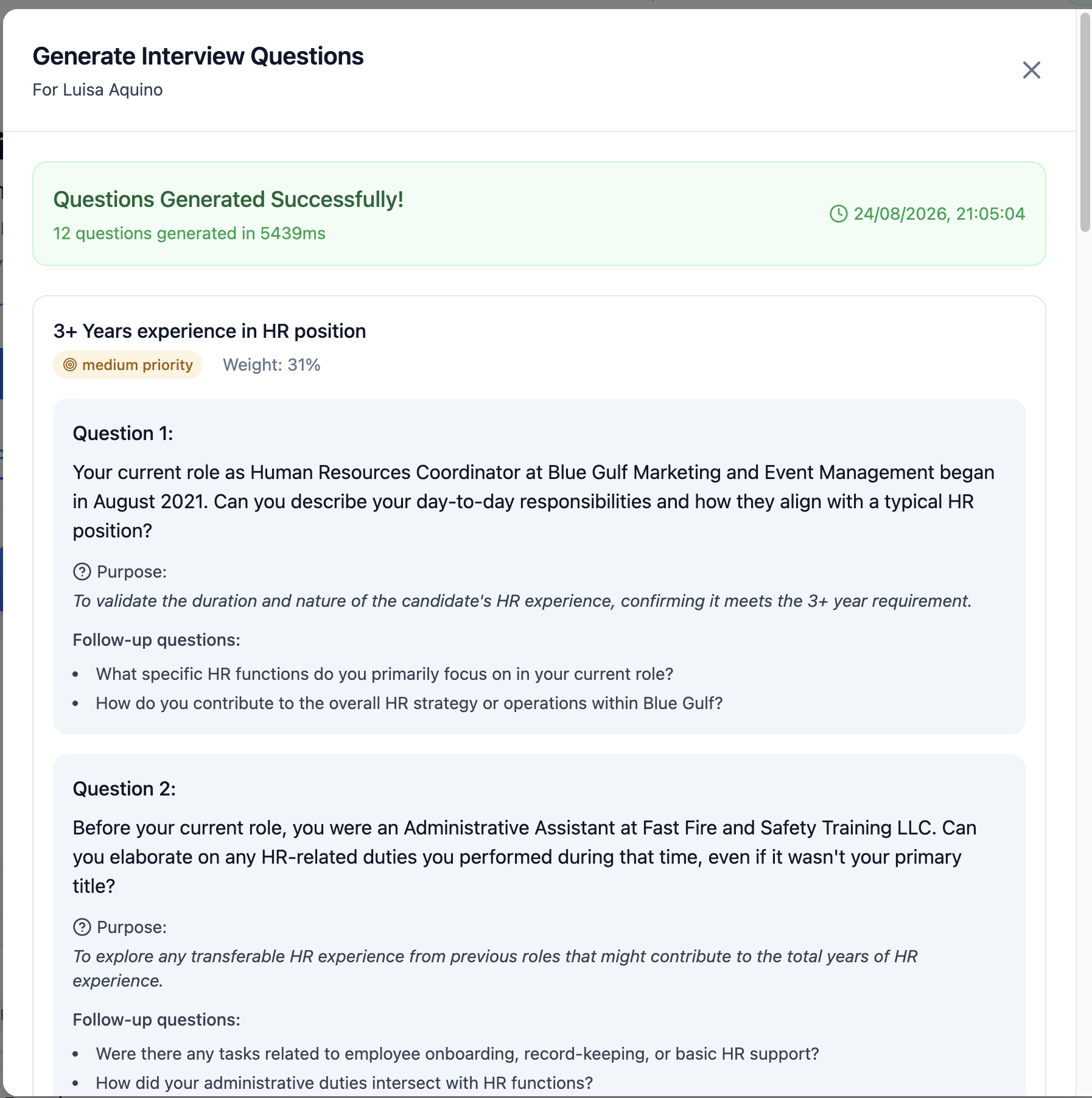
The process works by taking the screening criteria you have already defined - the skills, experience levels, and competencies you said matter for this role - and transforming them into interview questions that explore each criterion in depth. If your screening criteria include "experience managing cross-functional teams of 10+ people," the AI generates questions that specifically probe team management experience at scale, with follow-ups that explore challenges, conflict resolution, and outcomes achieved.
What makes this approach powerful is the connection between screening and interviewing. The candidate was identified as promising because they scored well against certain criteria and uncertainly against others. The generated questions naturally focus more heavily on the areas of uncertainty - the gaps where the AI screening could not definitively assess capability from the CV alone and where human conversation is needed to make a final determination.
Structuring Questions Across an Interview Panel
When multiple interviewers need to decide which interview questions to ask candidates, coordination becomes essential. Without structure, panels often ask overlapping questions, miss critical assessment areas entirely, or reach contradictory conclusions because each interviewer evaluated different things. Structured question allocation ensures coverage and prevents redundancy.
AI-generated question sets can be divided across panellists by criterion area. One interviewer assesses technical competency with their allocated questions. Another explores leadership and team dynamics. A third focuses on cultural alignment and communication style. Each receives their specific questions with purposes and follow-up guidance, ensuring the panel collectively covers every criterion without individual interviewers needing to cover everything.
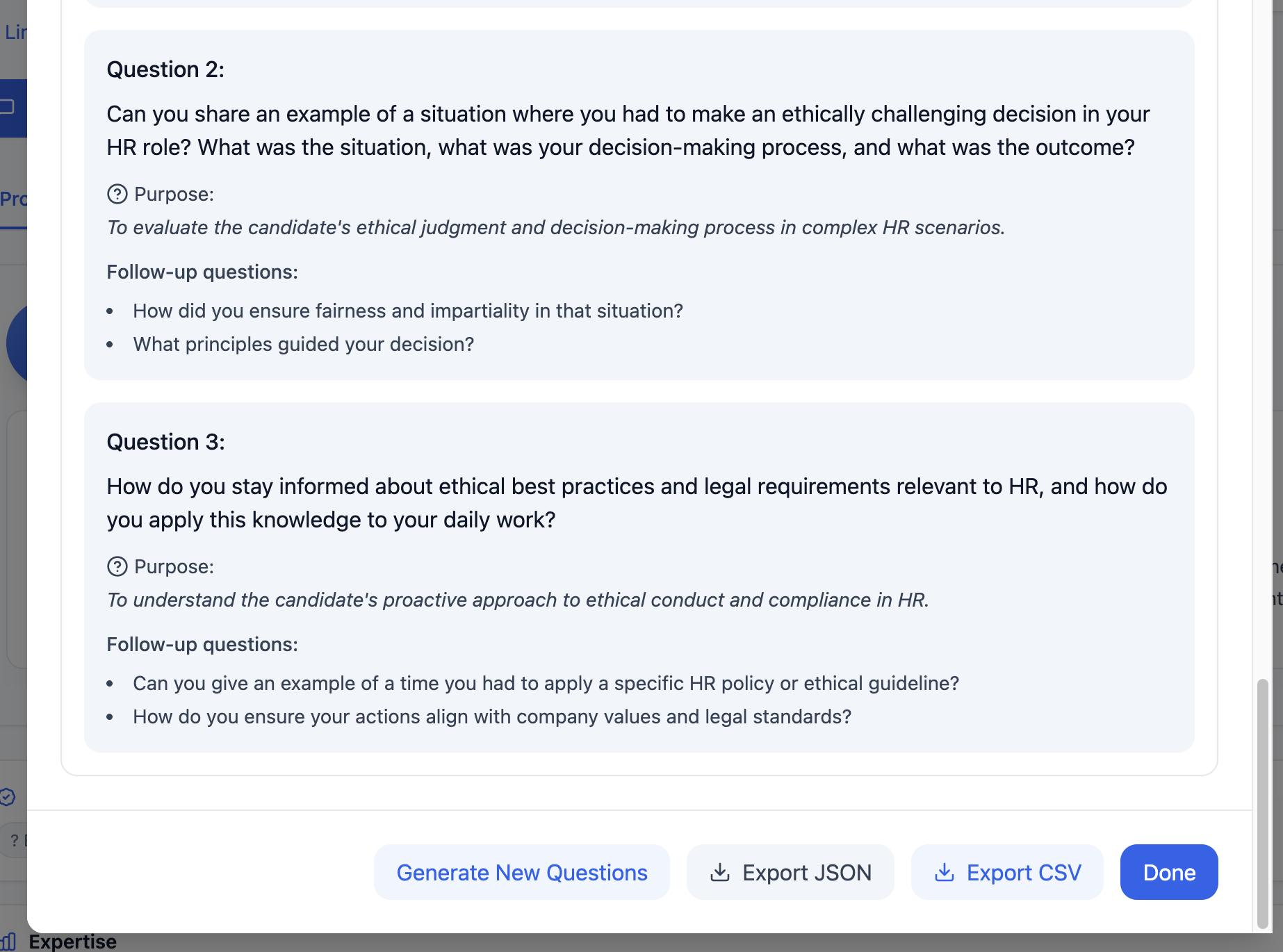
The export functionality in tools like GoVerse allows these structured question sets to be shared as documents that panellists can review before the interview. Each person arrives knowing their assessment responsibilities, their specific questions, and the follow-up paths available to them. The interview becomes a coordinated assessment rather than a collection of individual conversations.
Beyond Generic Interview Questions: What to Ask Candidates in 2026
Static question banks - the lists of "50 best interview questions" that populate recruitment blogs - serve a purpose as inspiration, but they fundamentally cannot account for the specificity that effective interviewing requires. A question that works brilliantly for assessing a senior marketing director is irrelevant for a clinical nurse specialist. A question perfect for exploring startup experience means nothing when assessing someone for a compliance role.
The future of interview preparation lies in dynamically generated questions that account for the specific role, the specific criteria, and the specific candidate. When interview questions are generated from the same criteria that powered the screening assessment, the entire hiring process maintains coherence from job definition through to final interview. Every stage asks the same fundamental question - can this person do what we need? - with increasing precision and depth at each step.
Whether you adopt AI tools for this purpose or invest the manual preparation time to build criterion-aligned question sets, the principle remains the same: the best interview questions to ask candidates are always those that directly target the capabilities the role requires, supported by follow-up paths that reveal depth, and structured to ensure consistency across every interview for every candidate.
Frequently Asked Questions
What are the best interview questions to ask candidates?
The best interview questions to ask candidates are competency-based questions tied directly to the skills the role requires. Rather than asking about abstract strengths, they ask candidates to describe specific past experiences that demonstrate the capability you need, because past behaviour in relevant situations is the strongest predictor of future performance.
What are good interview questions to ask applicants?
Good interview questions are specific, evidence-seeking, and open natural follow-up paths. Strong examples include "Tell me about a time you influenced a decision-maker who initially disagreed with you" and "Describe a technical challenge where your first approach failed. How did you diagnose and solve it?" Each targets a defined competency and invites a concrete example rather than a rehearsed answer.
What questions should you not ask in an interview?
Avoid questions about protected characteristics (age, marital or family status, religion, ethnicity, health or disability) and low-validity classics like "What is your greatest weakness?" or "Where do you see yourself in five years?" They measure interview performance, not job performance, and can create legal and bias risk.
What are behavioural interview questions?
Behavioural interview questions ask candidates to describe how they handled a specific real situation in the past. For example, "Tell me about a time you resolved a conflict within your team." They work because concrete past behaviour predicts future behaviour far better than hypothetical or self-assessment questions.
How many questions should you ask in an interview?
For a structured one-hour interview, plan 5–8 core competency questions, each with 2–3 follow-ups, leaving time for the candidate to ask their own. Coverage matters more than quantity. Every question should map to a criterion the role requires.
How does GoVerse generate interview questions?
GoVerse takes the screening criteria you have already defined and generates tailored interview questions for each one, calibrated to the individual candidate, focusing on the areas where the CV alone could not confirm capability. Each comes with its purpose and suggested follow-ups, and can be exported for an interview panel.
Generate tailored interview questions in seconds
GoVerse generates structured interview questions directly from your screening criteria, complete with follow-up guidance and easy export for your interview panel.
Start free trial →