A candidate relationship management system that engages every candidate at scale
GoVerse is an AI-powered candidate relationship management system. Multi-channel engagement that screens, nurtures, and keeps candidates warm across voice, email, SMS, and WhatsApp. Every interaction tracked. Every touchpoint personalised.
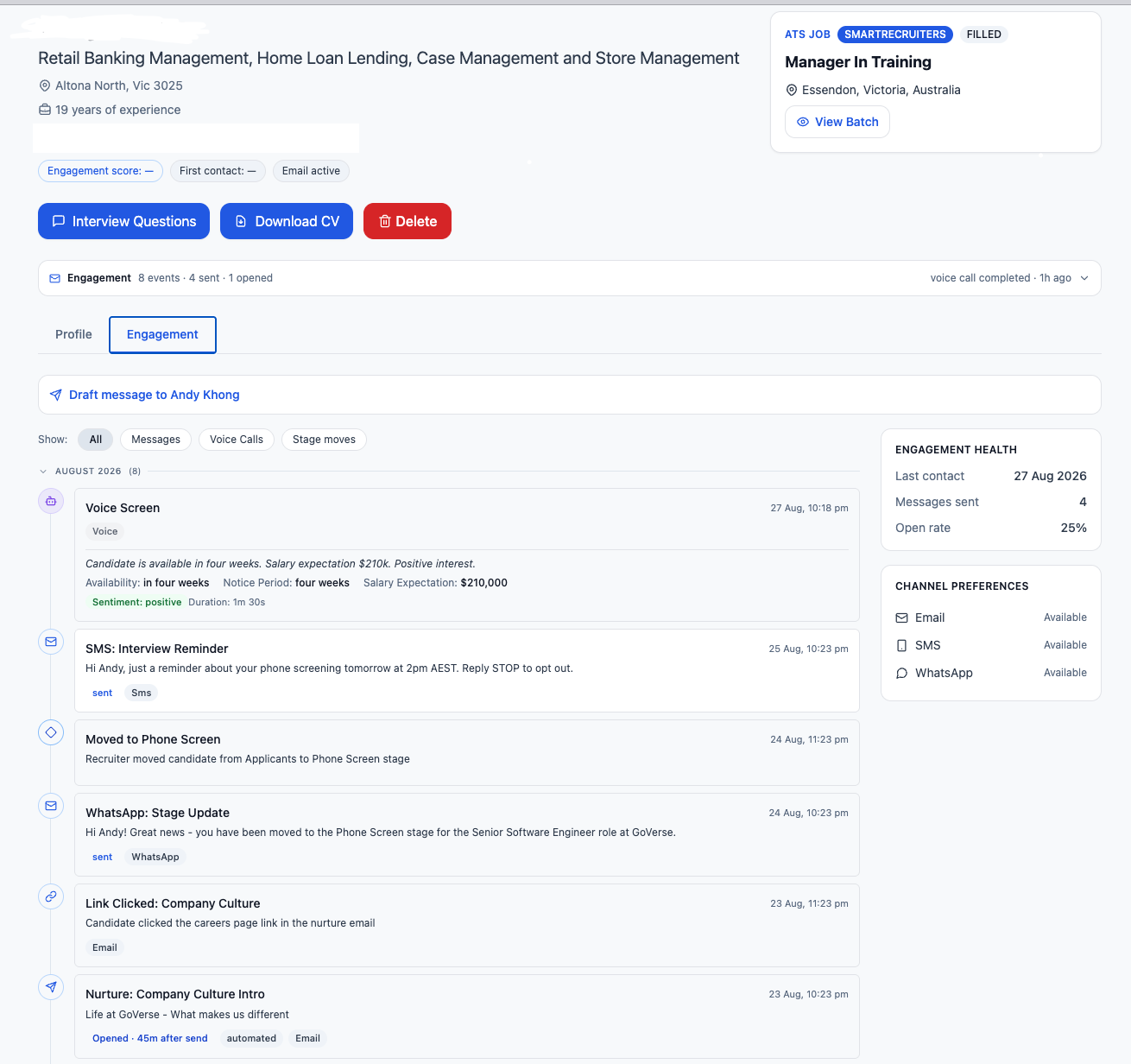
Every channel. One timeline.
Candidates don't live in one channel. Neither should your engagement. GoVerse orchestrates across voice, email, SMS, and WhatsApp, with a unified timeline showing every interaction.
AI Voice Screening
AI agent calls candidates, conducts structured screening, and proactively collects missing information so every applicant gets a fair and equal opportunity to be considered. Configurable per role.
AI-generated personalised emails for stage notifications, nurture sequences, and interview prep. Open and click tracking built in.
SMS
Quick-touch messages for interview reminders, schedule confirmations, and time-sensitive updates that need immediate attention.
Rich conversations on the platform candidates already use. Stage updates, document collection, and two-way communication.
AI screens candidates by phone so you don't have to
GoVoice is an autonomous AI agent that calls candidates, conducts natural screening conversations, and proactively collects information needed for fair evaluation. It gathers whatever data points each role requires, ensuring every candidate has an equal opportunity to provide the information needed for ranking, regardless of what's on their CV.
- ✓ Natural conversational voice, not a robocall
- ✓ Flexible data collection, configurable per role, not fixed questions
- ✓ Fairness measure: proactively gathers missing info for equal opportunity
- ✓ Sentiment analysis and candidate interest scoring
- ✓ Full transcript and AI summary for recruiter review
- ✓ Respects candidate preferences: stops if they ask
- ✓ Available 24/7: screens across time zones
Screening results
"Candidate expressed strong interest in the role. Available to start within 4 weeks. Salary aligned with range."
Nurture sequences that keep candidates warm
Don't lose great candidates to silence. Automated multi-step sequences engage talent pools, keep pipeline candidates informed, and re-activate past applicants.
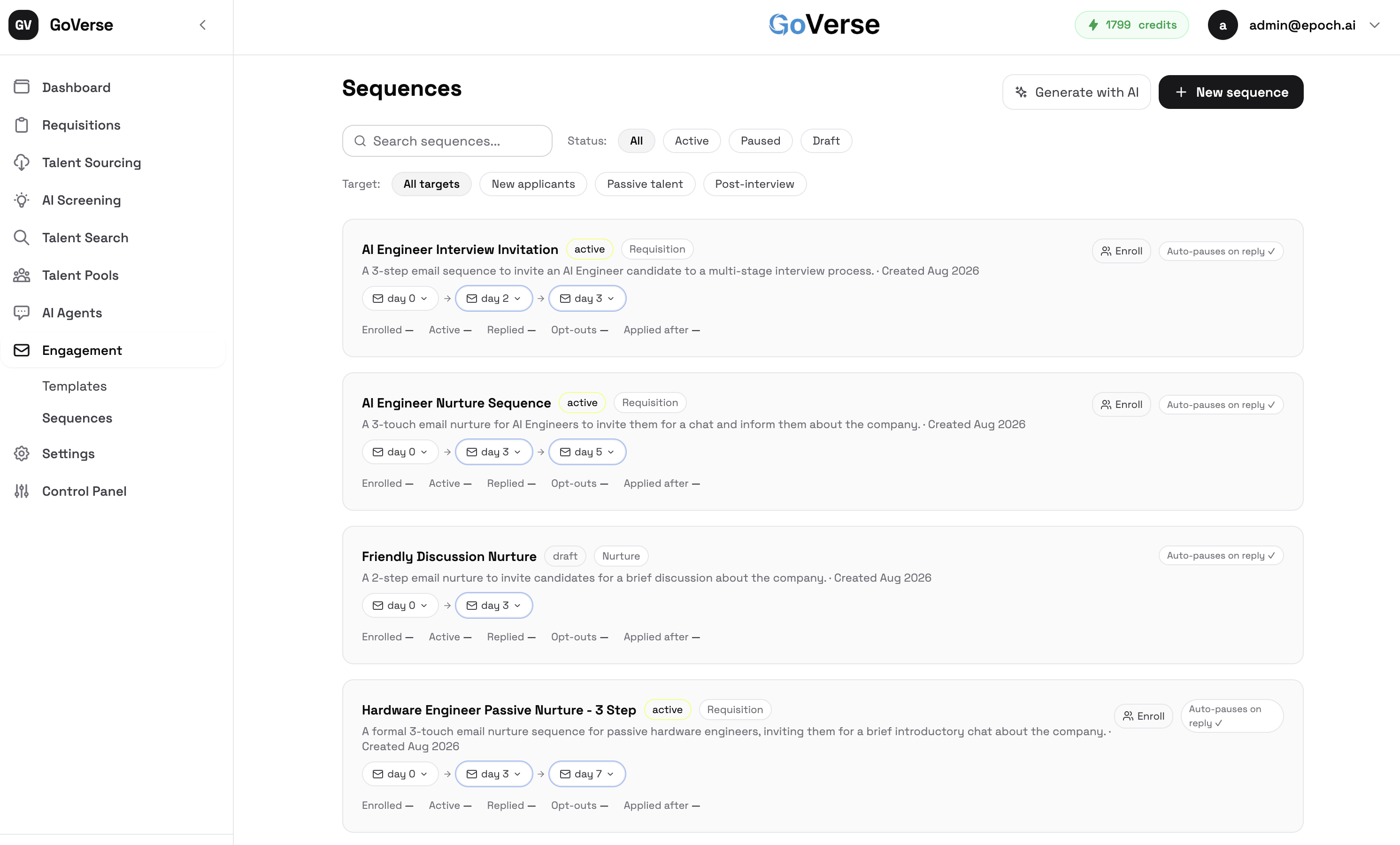
Pipeline sequences
Automatic notifications when candidates move stages. Interview prep, offer details, onboarding info, all personalised by AI.
Talent pool nurture
Keep silver-medal candidates engaged for future roles. Company culture content, new openings, and re-engagement campaigns.
Smart timing
Frequency guards prevent over-communication. Business-hour delivery. Respect opt-outs. Stop on reply.
Complete engagement history at a glance
Every email, call, SMS, stage move, and candidate interaction in one chronological timeline. Filter by channel, collapse by month, click to expand details.
Unified timeline
Voice screenings, emails, SMS, WhatsApp, stage moves, and system events, all in one chronological view per candidate.
Delivery tracking
See which messages were opened, clicked, bounced, or suppressed. Know exactly what each candidate has received.
Candidate preferences
Preferred channel, opt-out management, frequency preferences. Candidates control how they're contacted.
Engagement scoring
Quantified engagement based on opens, replies, clicks, and call outcomes. Prioritise the most responsive candidates.
Event-driven workflows
Trigger engagement automatically based on candidate actions and pipeline events. No manual follow-up required.
Why candidates go quiet, and how to stop it
Most candidates do not drop out because they found a better role. They drop out because nothing happened for two weeks and they assumed the worst. Silence is the single biggest leak in a hiring pipeline, and it is entirely self-inflicted. A recruiter juggling forty open roles cannot manually message every candidate at every stage, so the people in the middle of the process quietly cool off while attention goes to the next fire. Engagement automation exists to close that gap: the routine touches happen on time, every time, and the recruiter's attention goes to the conversations that actually need a human.
GoVerse keeps the touches personal rather than templated. A stage-move email references the specific role and what comes next, not a generic "thank you for your application". The AI writes from the candidate's profile and the pipeline event that triggered it, so a message reads like someone paid attention. Frequency guards sit on top of all of it, so a candidate never gets three messages in a day because two workflows fired at once. Business-hour delivery and stop-on-reply are on by default, because the fastest way to look like a spam bot is to text someone at 2am and keep going after they answer. The same signals that keep candidates warm also help you spot and reduce employee attrition with AI.
What GoVoice collects, and why it is a fairness measure
CVs are uneven. One candidate lists salary expectations, notice period and availability; another leaves all three off and gets ranked lower for gaps that have nothing to do with their ability. GoVoice calls candidates and gathers the same data points from everyone, so ranking is based on comparable information rather than on who happened to write a more complete CV. The enriched profile then feeds AI candidate screening, where every score is explained. That is the point most voice tools miss. The value is not that a machine made the call. It is that every candidate got the same chance to provide the information a fair ranking needs.
The conversation is configurable per role rather than a fixed script, and it runs 24/7 across time zones so a candidate in another city is not disadvantaged by office hours. Each call comes back with a full transcript, an AI summary, sentiment, and an interest score, all dropped onto the candidate's timeline next to their emails and stage moves. If a candidate asks the agent to stop, it stops. The recruiter reviews the summary in seconds instead of scheduling and running dozens of first-round phone screens by hand.
Frequently asked questions
Does automated engagement feel impersonal to candidates?
It feels the opposite when done right. The alternative candidates actually experience is silence. Messages are written from each candidate's profile and the real pipeline event behind them, delivered in business hours, and capped so nobody is over-messaged. Automation handles the timing; the content still reads like a person wrote it.
Which channels can I use, and can candidates choose?
Voice, email, SMS and WhatsApp, all on one timeline. Candidates set a preferred channel and can opt out or change frequency, and workflows respect those preferences automatically.
What happens to candidates we don't hire?
A rejection can trigger a respectful message and move the candidate into talent-pool nurture, so a strong applicant for one role stays warm for the next. That is how a silver-medal candidate becomes your fastest future hire instead of a name you forgot in the database.
What is the difference between a candidate relationship management system and an ATS?
An ATS is a system of record built around requisitions and compliance: it tracks who applied to which role and moves them through stages. A candidate relationship management system is built around people and the long game: it keeps candidates warm with nurture, re-engagement, and multi-channel follow-up, including people who have not applied yet. Most teams run both. GoVerse adds the CRM layer on top of the ATS you already use (Workday, SAP SuccessFactors, SmartRecruiters) rather than replacing it.
What makes GoVerse an AI-powered candidate relationship management system?
Most candidate relationship management systems are passive databases you have to remember to update. GoVerse acts on the relationship itself. It screens candidates by voice, writes personalised messages from each candidate's profile, and triggers the next touch automatically on pipeline events, all captured on one unified timeline across voice, email, SMS, and WhatsApp.
Does a candidate relationship management system work with talent pools?
Yes. Talent pools are where a candidate relationship management system earns its keep. GoVerse keeps pooled and silver-medal candidates engaged with nurture sequences, and semantic talent search resurfaces the right people when a new role opens, so a new requisition starts with a warm shortlist instead of a cold search.
What is a candidate relationship management system?
A candidate relationship management system is software that tracks and manages every interaction a company has with its talent, from first contact through hire and beyond. Think of it as the recruiting version of a sales CRM. Instead of accounts and deals, it holds candidates, conversations, and the next step for each one. The job it does is simple to describe and hard to do by hand: keep a complete, current record of every candidate so nobody is forgotten, and make the next touch easy to send on time. A good candidate relationship management system turns a scattered pile of emails, spreadsheets, and half-remembered phone calls into one timeline you can act on.
The common question is how a recruiting CRM differs from an applicant tracking system. An ATS is built around requisitions and compliance. It records who applied to which role, moves them through defined stages, and stores the audit trail you need when a role closes. It is a system of record. A candidate relationship management system is built around people and the long game. It cares about candidates who have not applied yet, silver-medal applicants from a role that filled months ago, and former employees worth a call. An ATS answers "who is in the pipeline for this req right now?". A CRM answers "who do we know, how warm are they, and when did we last talk?". Most teams run both: the ATS handles the active req, the CRM keeps the wider relationship alive so the next req starts with a warm shortlist instead of a cold job board.
The practical gap between the two is nurture. An ATS rarely reaches out on its own. A candidate relationship management system is where sequences, re-engagement, and multi-channel follow-up live, because those activities are about the relationship rather than a single application. That is also where the difference between a passive database and an active system shows up: storing a contact is easy, keeping that contact warm over months without manual chasing is the part that actually moves hiring outcomes.
How GoVerse works as an AI-powered candidate relationship management system
Candidate relationship management systems do for recruiting what a sales CRM does for revenue. They keep every person, every conversation, and every next step in one place, so nobody falls through the cracks. The difference with GoVerse is that the relationship work is AI-powered. The system does not just store contacts, it screens, nurtures, and follows up on its own, then hands the recruiter a timeline that reads like someone had been paying attention the whole time.
Where a traditional candidate relationship management system is a passive database you have to remember to update, GoVerse is active. Voice screening, email, SMS, and WhatsApp all write to the same unified timeline, so a recruiter opens one candidate and sees the full history across channels rather than piecing it together from four tools. Nurture sequences keep talent-pool and silver-medal candidates warm without manual effort, and semantic talent search resurfaces them when a new role opens. Engagement scoring surfaces who is actually responding. It works alongside the systems you already run (Workday, SAP SuccessFactors, SmartRecruiters), so the CRM layer sits on top of your record rather than replacing it.
Unified candidate record
One timeline per candidate across voice, email, SMS, WhatsApp, and stage moves. The core of any candidate relationship management system, kept current automatically.
Multi-channel nurture
Automated sequences keep pipeline and talent-pool candidates engaged, with frequency guards and stop-on-reply so relationships stay warm, not spammed.
AI that does the follow-up
The system screens by voice, drafts personalised messages, and triggers the next touch on pipeline events, so the relationship advances without manual chasing.
Stop losing candidates to silence
AI voice screening. Multi-channel nurture. Complete engagement history. All from one platform.
Start free trial →