AI interview: structured voice screening you can actually explain
Build interview criteria with Milo, let GoVoice call candidates and run a natural screening conversation, then score every answer against your attributes with reasoning you can read.
Free for 1 month. No credit card required.
Helps you build criteria and collect the attributes to assess
Calls candidates and runs a natural screening conversation
Black-box decisions. Every score shows its reasoning
Build your interview criteria with Milo
Milo is GoVerse's conversational assistant, built on LangChain. Instead of staring at an empty question form, you tell Milo what the role needs and it helps you shape the interview criteria: the skills, experiences, and attributes you actually want to assess. It structures those attributes so each one maps to something GoVoice can ask about and something the scoring step can measure.
The point is consistency. When every candidate is assessed against the same clearly defined attributes, you compare people on the same ground rather than on how a particular conversation happened to go.
Let GoVoice run the screening conversation
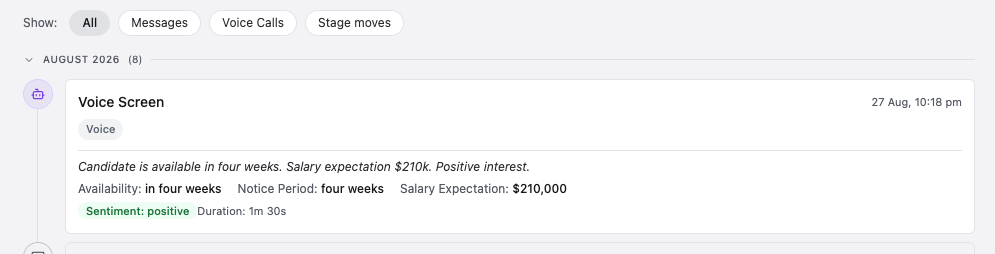
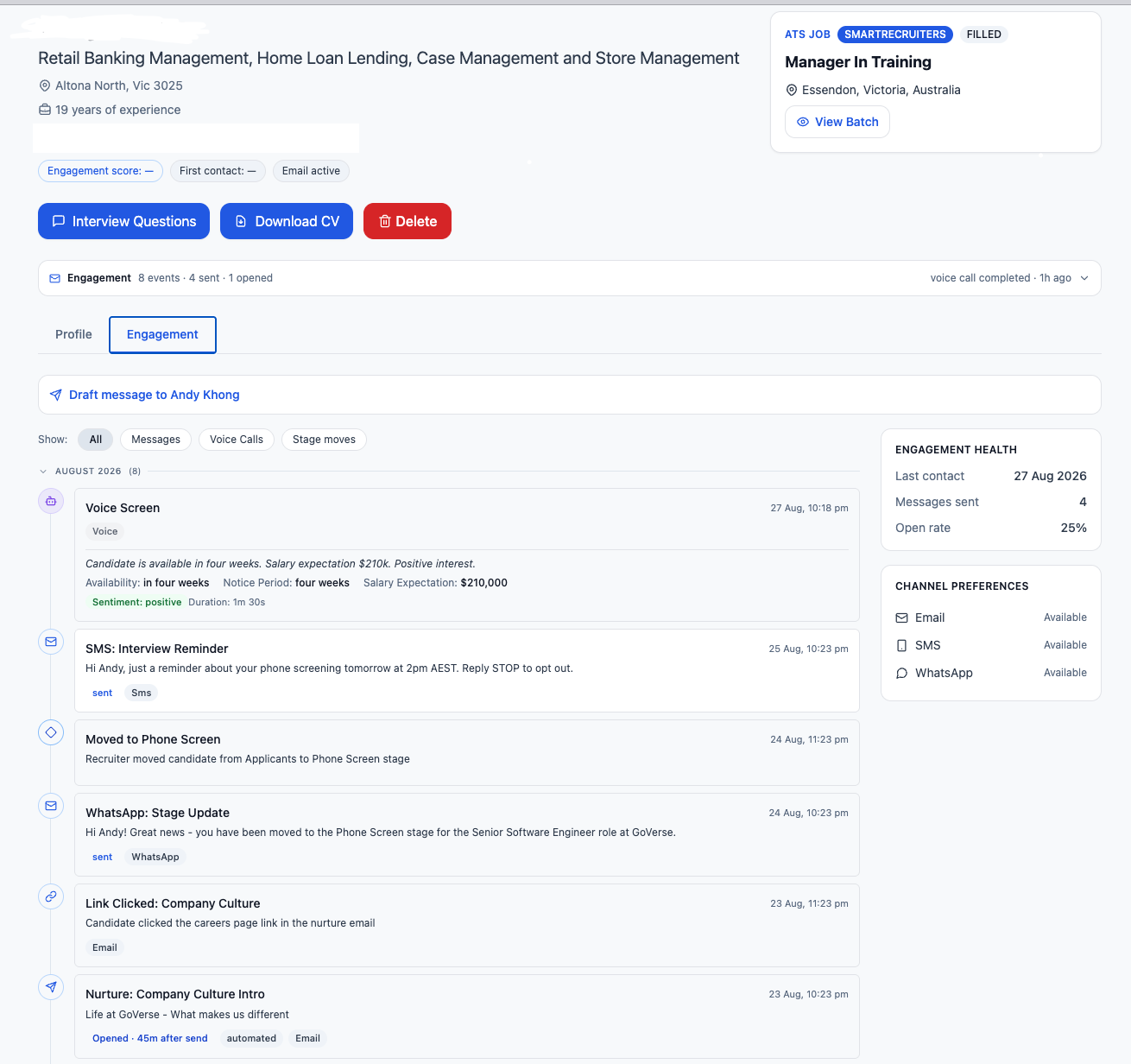
GoVoice is GoVerse's AI voice screening agent. It calls the candidate, holds a natural spoken conversation around the attributes you defined with Milo, and collects structured data from what the candidate says. Candidates speak to a patient, consistent interviewer that asks the same core questions every time, at a time that suits them.
You get a transcript and structured results, not a mystery signal. Because the assessment rests on the candidate's actual answers, you can read exactly what was asked and what was said.
How an AI interview runs on GoVerse
Shape interview criteria and attributes with Milo
GoVoice calls candidates and runs the screening conversation
Transcript and structured data feed explainable scoring
Review the reasoning, compare candidates, and decide
What AI interview actually means
AI interview is a broad term, and plenty of vendors use it to mean very different things. Some run one-way video where candidates record answers for later review. Some go further and claim to read facial expressions or voice tone to infer confidence or honesty. GoVerse takes a narrower, more defensible path. For us, an AI interview is a structured screening conversation: an AI voice agent asks the questions that matter for the role, the candidate answers in their own words, and the words are what get assessed.
That framing is deliberate. A spoken answer, written down as a transcript and scored against defined criteria, is something a recruiter can read, a hiring manager can challenge, and an auditor can inspect. A number pulled from someone's facial micro-movements is none of those things. So when GoVerse says AI interview, it means AI-assisted criteria and attribute collection with Milo, plus AI voice screening with GoVoice, feeding into scoring that explains itself. The same comprehension powers our AI candidate screening for CVs earlier in the funnel.
What GoVoice assesses in a conversation
You decide what matters for each role when you build the criteria with Milo. GoVoice then holds the conversation around those attributes and returns structured results that explain how each one came out.
Role-specific skills
Spoken answers that show whether a candidate has done the kind of work the role needs, assessed from what they describe rather than from keywords.
Experience in context
How a candidate talks through past responsibilities and situations, so scope and relevance come through, not just a job title.
Practical fit
Availability, notice period, location, and other role requirements you asked GoVoice to confirm during the call.
Your custom attributes
Anything else you defined with Milo for the role, checked for bias and non-job-related factors before candidates are called.
Scoring you can explain to anyone
A screening result is only useful if you know what sits behind it. GoVerse builds each candidate's result from the attributes you defined with Milo, drawing on the structured data GoVoice captured from the conversation. Every attribute carries written reasoning tied to what the candidate said, so the result is a set of judgements you can read, not a single opaque figure.
That matters in two situations most teams hit regularly. First, when a hiring manager disagrees with where a candidate landed, you point to the exact attribute and the words behind it instead of arguing about a hidden number. Second, when a candidate or a regulator asks why someone was not progressed, you have a transcript and a written, criteria-based reason on record. A score without reasoning is a ranking you take on faith. A score with reasoning, backed by a transcript, is a decision you can defend. For the written word earlier in the pipeline, our CV screening works the same explainable way.
Fairness and compliance
Voice screening done carelessly can bake in the same bias as any other hiring step. GoVerse reduces that risk in a few concrete ways. Every candidate for a role is asked about the same attributes, so the comparison is consistent rather than dependent on who ran the call. The attributes themselves are checked for protected characteristics and non-job-related factors before any candidate is contacted. And because the assessment rests on a transcript, there is a reviewable record of what was asked and answered.
This is why GoVerse favours transcript-based, explainable screening over opaque video or tone analysis. Inferring traits from a face or a voice signal is hard to validate, hard to explain, and hard to defend if challenged. A written answer scored against job-related criteria is auditable by design. If governance is front of mind, see our responsible AI and compliance approach.
What GoVerse does, and what it does not
Being honest about scope matters more than a long feature list. Here is the plain version so you know exactly what you are getting.
What GoVerse does
- Helps you build interview criteria and collect attributes with Milo, our LangChain assistant.
- Runs AI voice screening calls with GoVoice, holding a natural spoken conversation.
- Captures a transcript and structured data from each conversation.
- Feeds that into explainable scoring with reasoning you can review and override.
- Checks your attributes for bias and non-job-related factors before calls go out.
What GoVerse does not do
- No one-way or async video interviews.
- No facial analysis or body-language reading.
- No voice-tone or emotion scoring.
- No hidden, black-box decisions: a human stays in the loop.
- No replacing the live interview or reference checks. This is screening, not the final decision.
Where AI interviewing fits, and where it does not
Voice screening earns its keep on volume. When a role pulls a long list of applicants and you need to find the handful worth a human interview, having GoVoice call every candidate and return consistent, scored results saves hours of scheduling and repetitive phone screens. Candidates get a response and a conversation quickly, which beats sitting in silence for a week.
It is a weaker fit for the final-stage interview, where a hiring manager wants to probe deeply, test chemistry, and make a call on a person. GoVerse does not try to be that. Treat the AI interview as a consistent, explainable top-of-funnel screen that decides who is worth your team's time, and keep the human interview for the decision itself. Used that way, it does its job well.
Frequently asked questions
What does AI interview mean at GoVerse?
At GoVerse, an AI interview is a structured, voice-based screening conversation run by GoVoice, our AI voice agent. It calls the candidate, asks the questions tied to the attributes you want to assess, and returns a transcript plus structured data. Milo, our conversational assistant, helps you build the interview criteria beforehand. There is no video, no facial reading, and no tone scoring: the assessment is based on what the candidate actually said.
Does GoVerse do one-way video interviews?
No. GoVerse does not run one-way async video interviews and does not analyse faces, body language, or voice tone. We favour transcript-based, explainable screening over opaque video analysis, because a written record of what was asked and answered is far easier to review, audit, and defend than a facial or tonal signal.
How does GoVerse keep AI interviewing fair?
Every GoVoice conversation follows the same criteria for every candidate, so people are compared on consistent ground rather than on who caught the recruiter on a good day. The attributes Milo helps you define are checked for protected characteristics and non-job-related factors, and every scored result comes with written reasoning you can review and override.
Can I review and change the scores?
Yes. GoVoice collects structured data from the conversation and feeds it into explainable scoring that shows the reasoning behind each result. A recruiter stays in the loop: you read the transcript, see why each attribute scored the way it did, and can override any result. Nothing is a black box.
Can I try AI interviewing for free?
Yes. You can set up interview criteria with Milo and run GoVoice voice screening during your free month, no credit card required. Register and build your first criteria set in a few minutes.
Ready to run your first AI interview?
Build criteria with Milo and let GoVoice do the screening calls.
Start free →