AI scoring that explains every number
GoVerse rates each candidate 0 to 100 against your weighted criteria, with a written reason for every score tied to the evidence in their CV. No hidden percentages.
Free for 1 month. No credit card required.
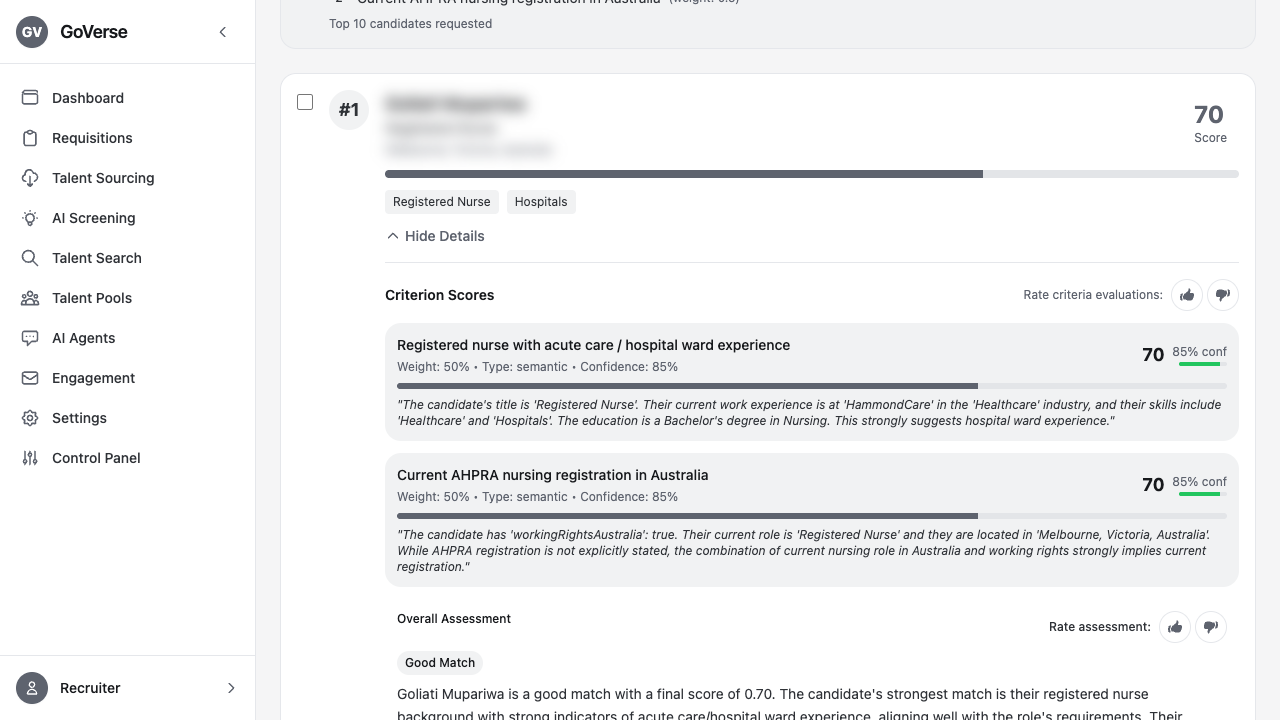
Weighted score per candidate
Scores with written reasoning
Per CV scored
What AI scoring is
AI scoring is the practice of turning a candidate's application into a single, defensible number that reflects how well they fit a specific role. Instead of a recruiter forming a loose mental ranking after reading each CV, the AI reads every application, measures it against the criteria you set, and returns a score from 0 to 100 along with the reasoning behind it. The score is a summary. The reasoning is the point.
Most scoring tools stop at the number. They hand you a percentage and expect you to trust it, which is exactly the problem both candidates and regulators now push back on. GoVerse takes the opposite approach. Every score is assembled from named criteria, each with its own written rationale, so you can see which part of a CV earned which part of the score. That difference, between an opaque figure and an explained decision, is what makes a score worth acting on. The same comprehension drives our candidate screening and semantic talent search.
How GoVerse builds a score
You define the criteria that matter for a role and assign each a weight. GoVerse reads every candidate, judges them against those criteria semantically rather than by keyword, writes a rationale for each one, and rolls the weighted judgements into a single 0-100 result you can trust and defend.
The three parts of a GoVerse score
A number on its own tells you nothing. These three mechanisms are what turn a GoVerse score into a decision you can stand behind in a hiring meeting or an audit.
Criteria weighting
You decide what counts and by how much. A must-have skill carries more weight than a nice-to-have, so the score reflects your priorities for that specific role rather than a generic template.
Semantic understanding
GoVerse reads for meaning, not matching strings. Equivalent skills, transferable experience and recognised qualifications all count, so strong candidates who word things differently are not scored down for it.
Per-criterion reasoning
Each criterion gets a written rationale pointing to the evidence in the CV that justified it. The 0-100 result is the sum of judgements you can read, question, and override.
How scoring works, step by step
Define weighted criteria or load a saved blueprint
The policy engine validates criteria for bias
AI scores each candidate 0-100 with written reasons
Review ranked scores, read the rationale, override if needed
Why explainable scoring matters for trust and compliance
A score you cannot explain is a liability waiting to surface. The moment a hiring manager disagrees with a ranking, or a rejected candidate asks why, an opaque percentage leaves you with nothing to say. Explainable scoring changes that. Because every GoVerse score is built from named criteria with a written rationale, you can point to the exact factor that moved a candidate up or down, in a hiring meeting or in a formal response.
That transparency is also moving from good practice to legal expectation. The EU AI Act classifies most hiring and candidate-evaluation systems as high-risk, with obligations around transparency, human oversight, and record-keeping. New York City Local Law 144 requires bias audits of automated employment decision tools and notice to candidates. Neither law is satisfied by a tool alone, but a scoring system that records weighted criteria, a bias check before each run, and a written reason per candidate gives you the audit trail those frameworks expect. Our responsible AI and compliance page goes deeper on how this is handled.
Bias-aware by default
Scoring criteria carry risk if nobody checks them. A criterion like "cultural fit" or an unnecessary location requirement can quietly stand in for a protected characteristic. GoVerse runs every set of criteria through a policy engine before a single candidate is scored. It flags protected characteristics and non-job-related factors so you catch them at the point of definition, not after a batch of candidates has already been ranked on a flawed rule.
This is deliberately placed before scoring rather than after. Fixing a biased criterion before the run means no candidate was ever evaluated against it. It keeps the human in control: the policy engine advises, you decide, and the whole exchange is part of the record. Scoring that is fast but indefensible is not worth having, so bias validation is not an add-on here, it is the first step.
Reusable scoring blueprints
Most teams hire the same shapes of role again and again. Rebuilding criteria from scratch each time wastes effort and quietly introduces inconsistency, where one recruiter weights a skill heavily and another ignores it. Scoring blueprints fix that. Save a set of weighted criteria once, name it, and apply it to any future requisition for that kind of role.
A blueprint for a backend engineer, a graduate intake, or a regional sales lead becomes a shared standard your team scores against every time. You can refine a blueprint as you learn what actually predicts success in a role, and every improvement carries forward to the next hiring round. The result is scoring that is consistent across recruiters, repeatable across cycles, and faster to set up with each use. Pair blueprints with skills-first matching to keep every score anchored to what the job genuinely needs.
Where scoring fits, and where it doesn't
AI scoring earns its place on volume. When a posting draws hundreds of applicants, reading every CV to find the handful worth interviewing is a poor use of a recruiter's day. GoVerse scores the whole field in minutes at roughly $0.01 per CV and hands you a ranked list with reasoning, so you spend your time on the shortlist rather than the slush pile.
It is a weaker fit where a CV simply cannot carry the decision. A founder's first hire, a niche executive search where you already know the ten people worth calling, or a judgement about how someone will grow. Scoring does not replace the interview, the reference check, or your read on a person. It replaces the hours spent deciding who is worth interviewing. Treat the score as the top of the funnel, keep a human on every final call, and it does its job well.
Frequently asked questions
What does an AI scoring tool actually measure?
GoVerse AI scoring produces a 0-100 result for each candidate, built from the individual criteria you defined and the weight you gave each one. A must-have skill contributes more than a nice-to-have, and recent hands-on experience counts for more than the same skill mentioned once years ago. Every criterion carries a written rationale tied to evidence in the CV, so the number is never a figure you have to accept on faith.
Is AI scoring explainable, or is it a black box?
It is explainable by design. GoVerse writes out why each candidate earned the score they did, criterion by criterion, pointing to the specific experience or qualification in the CV that justified it. There is no hidden percentage. If a hiring manager or an auditor asks why someone scored 72 and not 85, you have the reasoning on record.
How does AI scoring stay compliant with hiring law?
A bias-aware policy engine validates your scoring criteria before any candidate is evaluated, flagging protected characteristics and non-job-related factors. Combined with a written rationale per criterion, this supports the transparency and record-keeping expectations of frameworks such as the EU AI Act and New York City Local Law 144. Compliance still depends on how you use the tool, but the audit trail is there.
Can I reuse scoring criteria across roles?
Yes. Save a set of weighted criteria as a scoring blueprint and apply it to any requisition. A blueprint for a backend engineer, a sales lead, or a graduate programme can be reused and refined over time, so your scoring stays consistent across your team and across hiring rounds.
How much does AI scoring cost?
Scoring runs on credits. Plans are $49.99, $99.99 and $149.99 per month for 100, 300 and 600 credits respectively, which works out to roughly $0.01 per CV scored. You can start free for one month with no credit card to see the scores and reasoning on your own candidates first.
See the score and the reasoning on your own candidates
Upload a few CVs, set your weighted criteria, and read the 0-100 result with a written reason for every number.
Start free →