From AI Screening to Structured Interviews: How GoVerse Generates Tailored Questions
The gap between screening a candidate and interviewing them is where preparation time accumulates. GoVerse eliminates that gap by generating interview questions directly from your screening criteria - the same criteria that scored the candidate in the first place.
The Screening-to-Interview Disconnect
In most recruitment workflows, screening and interviewing operate as disconnected activities. A recruiter defines screening criteria, AI evaluates candidates against those criteria, and then a completely separate process begins: someone manually crafts interview questions, often without referencing the specific criteria that identified the candidate as worth interviewing in the first place. The intelligence gathered during screening rarely flows into the interview preparation.
This disconnect creates redundancy and inconsistency. Interviewers ask generic questions unrelated to what made the candidate promising. Critical criteria that the AI flagged as partially met - areas that need deeper exploration - go unexamined because no one translated the screening insight into an interview question. The candidate was screened intelligently but interviewed generically.
GoVerse solves this by treating screening criteria as the foundation for interview question generation. The same criteria that scored the candidate become the framework for exploring their suitability in person. The AI understands what was assessed, what scored well, what needs deeper investigation, and generates questions accordingly.
Generating Questions from Screening Criteria
The process begins where screening ends. After candidates have been scored against your criteria, GoVerse offers interview question generation that takes those exact criteria and produces structured, purposeful questions for each one. You select the candidate, choose the interview depth - whether it is a brief screening call, a technical deep-dive, or a comprehensive panel interview - and the system generates questions tailored to that specific candidate's profile against your specific requirements.
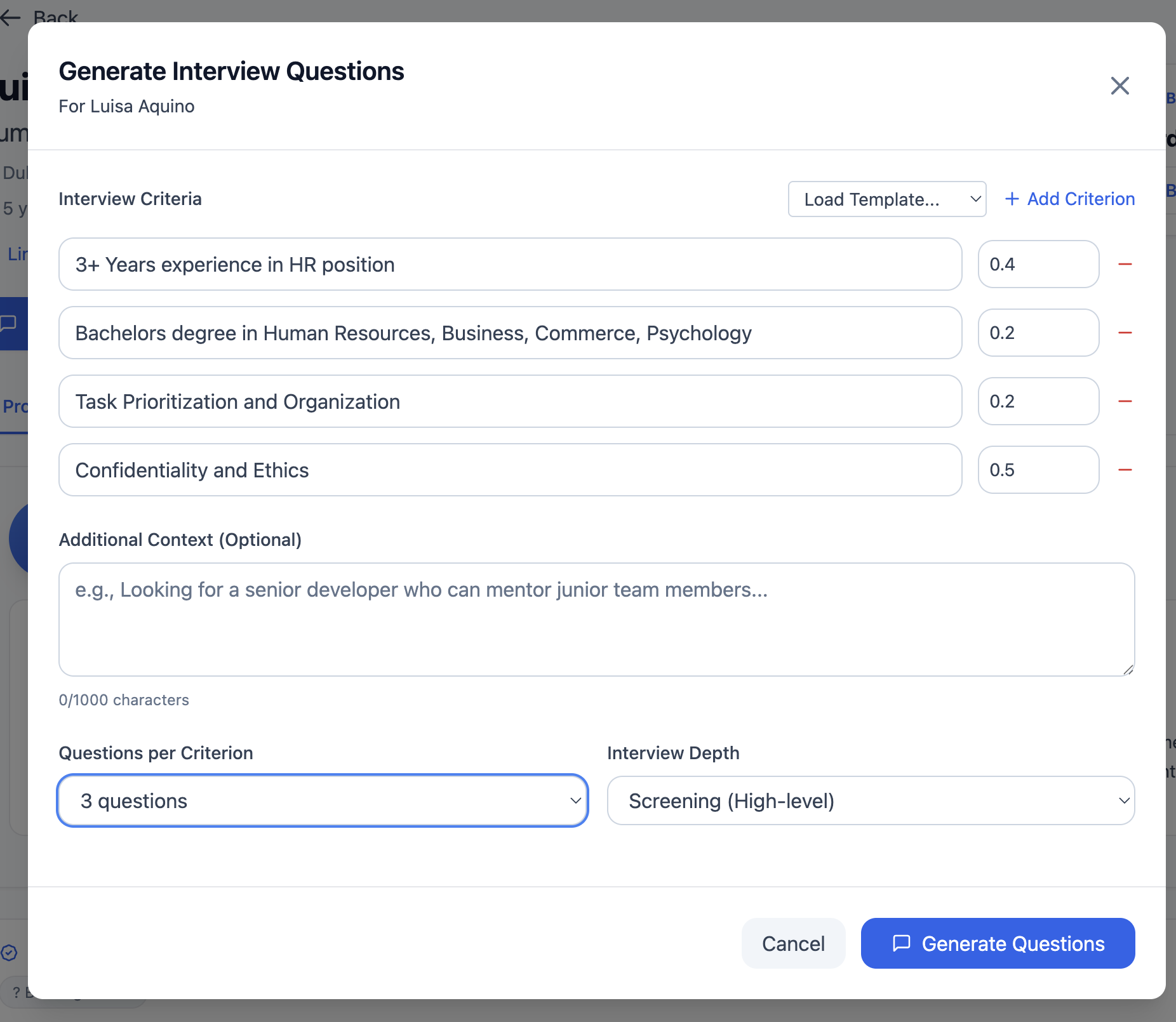
Each generated question is mapped to a specific criterion and includes a clear purpose statement explaining what the question aims to reveal. This means interviewers understand not just what to ask, but why they are asking it - what capability or experience gap the question is designed to explore. For hiring managers who did not participate in the screening configuration, this context is invaluable. They walk into the interview understanding the strategic intent behind each question.
Follow-Up Guidance for Deeper Exploration
A well-prepared interviewer does not just ask a question and move on. The richest insights come from follow-up questions that probe deeper based on the candidate's initial response. GoVerse generates suggested follow-up questions for each primary question, giving interviewers a roadmap for deeper exploration without requiring them to think on their feet about where to go next.
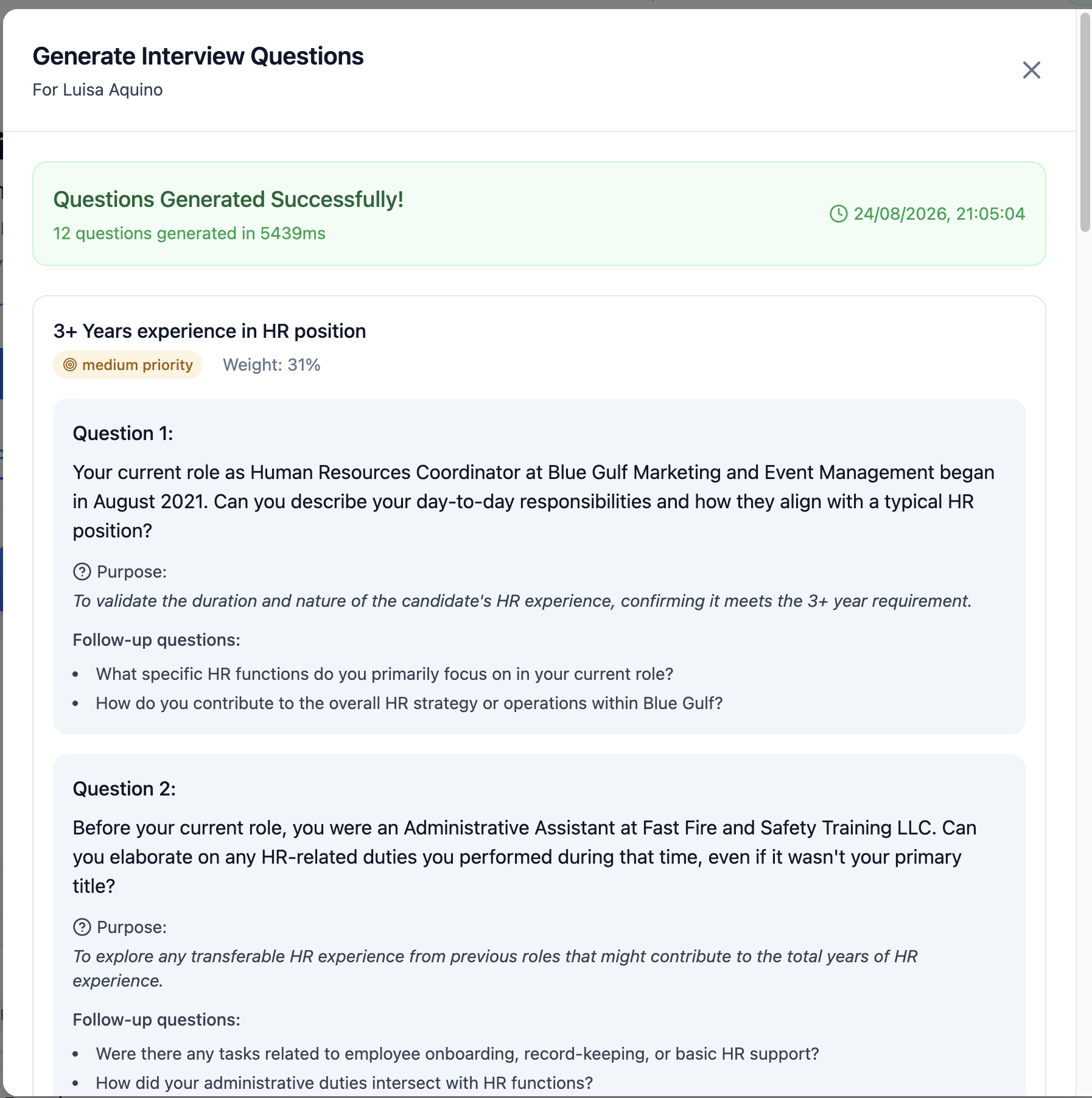
These follow-ups are not generic probes. They are generated with awareness of the candidate's profile and the specific criterion being assessed. If a candidate scored moderately on clinical leadership experience, the follow-up questions specifically explore scenarios where leadership was required, how they navigated team dynamics, and what outcomes resulted - drilling into the exact area where the screening flagged uncertainty rather than asking surface-level questions about leadership philosophy.
This approach transforms interviews from loosely structured conversations into purposeful assessments where every question serves a clear evaluative function. Interviewers feel more confident because they have a structured plan. Candidates receive a fairer assessment because every interviewer asks questions aligned with the actual role requirements rather than personal preferences or improvised topics.
Export and Share with Your Interview Panel
Interview preparation is rarely a solo activity. Panel interviews involve multiple people, each potentially responsible for different assessment areas. GoVerse allows interviewers to export generated questions as a structured document that can be shared with the entire panel. Each interviewer can see which criteria they are responsible for assessing, what questions to ask, what follow-ups to pursue, and what the purpose of each question is.
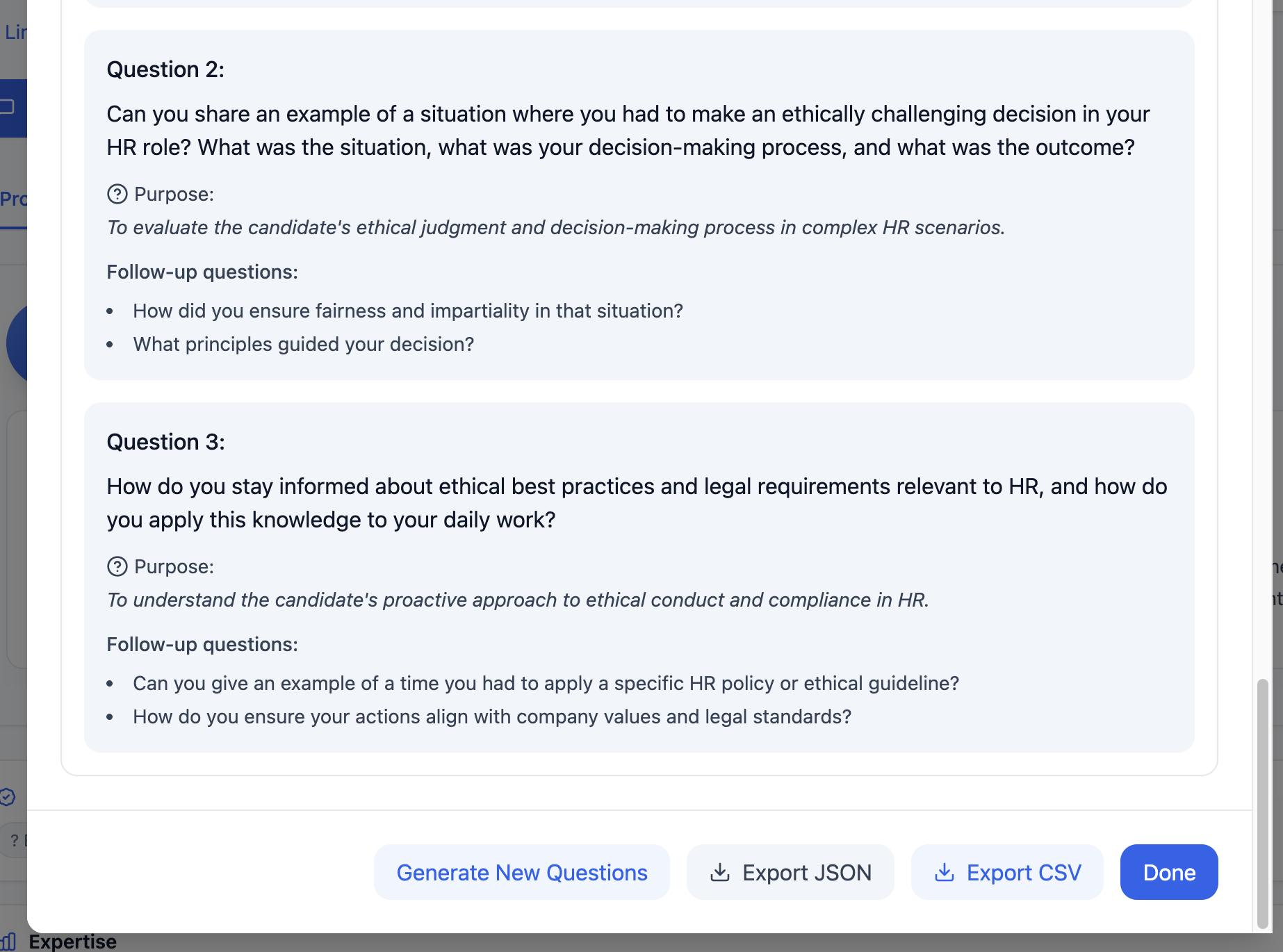
The export includes the criterion, the weight (how important it is relative to other criteria), the questions, their purposes, and the suggested follow-ups - everything a panellist needs to conduct a structured, criteria-aligned interview without requiring access to the platform itself. This is particularly valuable for hiring managers who participate in interviews but do not use the recruitment platform day-to-day.
Why This Matters for Hiring Quality
Structured interviews are consistently shown to be among the most predictive hiring methods. The challenge has always been the preparation required to make them structured - defining what to assess, creating questions that target those areas, and ensuring consistency across interviewers and candidates. GoVerse removes the preparation burden while maintaining the rigour that makes structured interviews effective.
When screening criteria flow directly into interview questions, the entire hiring process maintains alignment. What you said was important during the job definition phase carries through to how candidates are evaluated in screening, and then again in how they are assessed during interviews. There is no drift, no reinterpretation, no gap between what the role requires and what the interview explores. This alignment is what produces better hiring decisions - not because AI is making the decision, but because AI is ensuring that humans make decisions based on consistent, relevant information at every stage.
The interview that made a hiring manager change how he prepped
A hiring manager at a clinical services provider told me his prep routine used to be five minutes in the car park before the interview, reading the CV one more time and reusing the same questions he always asked. His words: "I ask everyone the same six questions, so at least it's consistent." Consistent, maybe, but the six questions had nothing to do with why this particular candidate had been shortlisted.
We generated questions for his next interview straight from the screening criteria that had scored the candidate. One criterion, clinical leadership, had come back moderate rather than strong. The generated question and its follow-ups pointed straight at that soft spot: a scenario question about a time the candidate led a team through a difficult shift, then follow-ups on how they handled a disagreement and what the outcome was. He walked in and asked exactly that. Afterwards he said the interview was the first in a while where he learned something the CV had not already told him. He has not gone back to the car-park six.
Before and after, in prep time and quality
Before, a panel interview at that provider meant the recruiter cobbled together a question list from a shared document, the hiring manager improvised, and the two of them sometimes asked the same candidate overlapping questions while missing whole areas entirely. Prep was inconsistent because it depended on who had time that week.
After, the questions came generated and mapped to criteria, each with a purpose statement and suggested follow-ups, and the recruiter exported them so each panellist knew which criteria they owned. Prep dropped from a scramble to a few minutes of reviewing a shared document. The quality change was less about speed and more about coverage: the panel stopped double-covering the easy areas and stopped skipping the awkward ones, because the questions were built around what the screening had actually flagged.
Why the purpose statement matters more than the question
Recruiters expected the value to be in the questions. Several told me the purpose statement next to each question was what actually helped, especially for hiring managers who had not set up the screening. Knowing that a question exists to probe a moderate score on stakeholder management, rather than just being a question about stakeholders, changes how an interviewer listens to the answer. They know what they are trying to find out.
What confused people at first
The first confusion was expecting to type in questions and have the AI polish them. That is not the flow. The questions are generated from the screening criteria, so if the questions feel off, the fix is usually in the criteria, not in editing question wording. A couple of users tried to force a topic that was not in their criteria and were puzzled it did not appear. Once they added the criterion, the relevant questions showed up.
The second was the interview depth setting. People did not always notice that choosing a brief screening call versus a full panel interview changed how many questions and how much depth they got. A recruiter generated a short set for what she thought would be a deep technical interview, then wondered where the detail was. She had left the depth on the shortest option. It is one dropdown, but it materially shapes the output, and it is easy to skip past.
One thing we still want to improve
The generated questions are strong at the criteria level, but they do not yet pull in enough of the candidate's specific history. If a candidate's CV mentions a particular project or employer that is worth digging into, the questions will explore the criterion but will not always name that project the way a human interviewer who read the CV closely would. We want the generation to weave in more of the individual's own detail, so a question can say "you mentioned leading the migration at your last role, walk me through that," rather than staying at the level of the general competency. It is a real gap, and closing it is active work. For now, the best interviews still come from a panellist reading the CV once alongside the generated set and adding one or two candidate-specific probes of their own.
Generate your first interview questions in seconds
Screen candidates with AI, then generate tailored interview questions directly from your criteria. Free 30-day trial, no credit card required.
Start free trial →