Why Every AI Hiring Decision Needs an Explanation
The era of unexplainable AI decisions in recruitment is ending. Regulators are closing in, candidates are demanding transparency, and organisations that cannot explain their automated hiring decisions are building a legal and ethical liability with every screen they run.
The Regulatory Walls Are Closing In
The European Union's AI Act classifies recruitment AI as "high-risk," requiring organisations to maintain detailed documentation of how their systems make decisions, conduct regular bias audits, and provide meaningful information to affected individuals. This is not a future concern - enforcement timelines are already in motion, and organisations deploying AI screening tools in the EU need to demonstrate compliance now, not later.
Across the Atlantic, New York City's Local Law 144 has been in effect since 2023, requiring annual bias audits of automated employment decision tools and mandating that candidates be notified when AI is used in their evaluation. The law has teeth: fines accumulate per violation, per day. Organisations that cannot produce audit documentation face both financial penalties and reputational damage in one of the world's most competitive talent markets.
In Australia, the National AI Ethics Framework establishes principles of transparency, explainability, and accountability for AI systems. While currently voluntary, the framework is rapidly evolving toward enforceable standards, and Australian organisations are being advised by legal counsel to treat these principles as de facto requirements. The global trend is unmistakable: jurisdictions are not asking whether AI hiring decisions should be explainable, but how quickly they can mandate it.
The Black-Box Problem in Recruitment
Most AI screening tools on the market today operate as black boxes. A candidate goes in, a score comes out, and the reasoning in between is either proprietary, incomprehensible, or simply nonexistent. The vendor might tell you that their model was "trained on successful hires" or "optimised for predictive validity," but when a candidate asks why they were rejected, or a regulator asks how decisions are made, these phrases collapse into meaninglessness.
The consequences of black-box hiring AI extend beyond compliance. When recruiters cannot understand why the system scored a candidate in a particular way, they cannot exercise professional judgement. They become rubber stamps for algorithmic outputs rather than informed decision-makers using AI as a tool. This erodes the recruiter's expertise over time and creates a fragile dependency on systems that nobody in the organisation truly understands.
Worse still, black-box systems are uniquely vulnerable to encoding bias. If a model learned from historical hiring data - which reflects decades of human bias - it will reproduce those patterns invisibly. Without per-decision explanations, discriminatory patterns can persist for months or years before anyone notices them in aggregate audit data. By then, the damage to candidates and to the organisation's reputation is done.
What Explainability Actually Looks Like
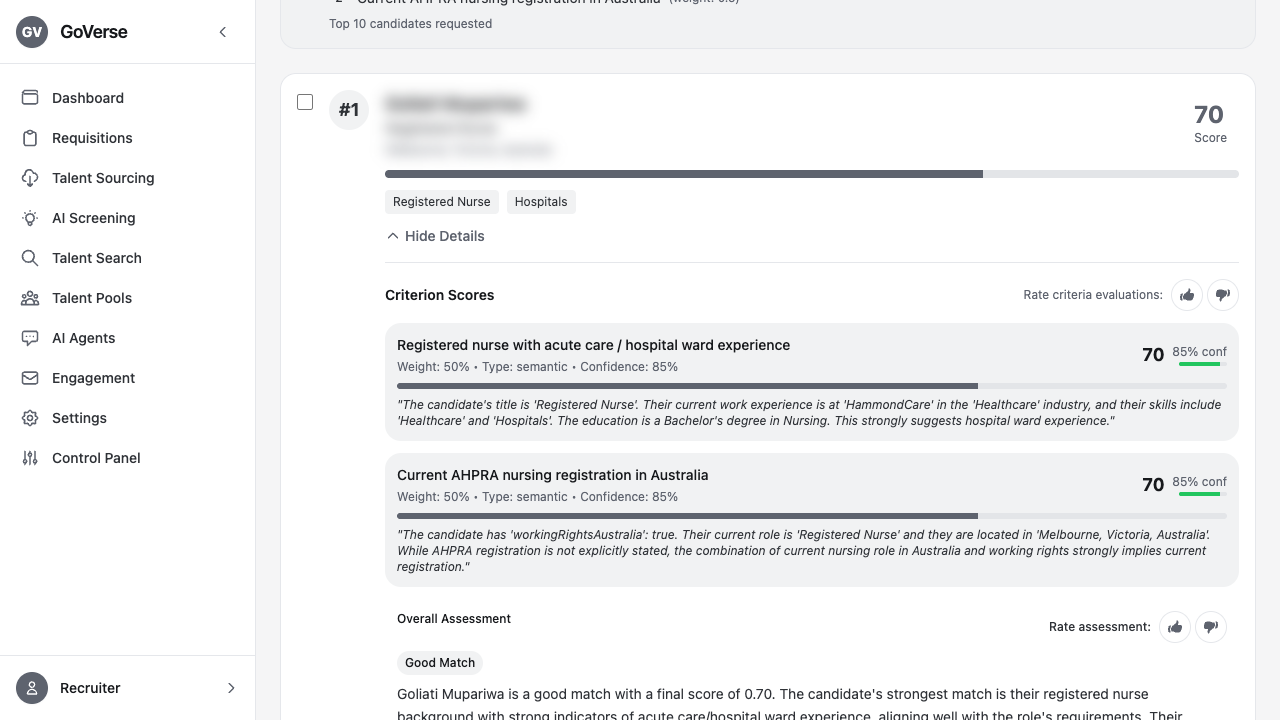
Genuine explainability in AI hiring is not a summary paragraph generated after the fact. It is architectural - built into how the system reasons about candidates from the first computation. At GoVerse, every screening decision produces a per-criterion breakdown: what the AI evaluated, what evidence it found in the candidate's profile, and how that evidence maps to the score assigned. The explanation is not a post-hoc rationalisation; it is the decision process itself, made visible.
This means that when a hiring manager asks "why was this candidate ranked third?", the answer is specific and traceable. It might be: "They scored highly on clinical experience and team leadership, but the system found no evidence of the quality improvement methodology specified in criterion four." The hiring manager can then exercise judgement - perhaps that methodology is trainable, and the candidate should advance anyway. The AI informed the decision without making it.
Explainability also means that when criteria are poorly defined, the system's reasoning makes that visible. If a criterion is too vague - "good cultural fit" - the AI's attempt to evaluate it will produce reasoning that reveals the vagueness. This creates a feedback loop that improves the quality of screening criteria over time, because unclear criteria produce visibly unclear reasoning.
The Audit Trail as Organisational Asset
Every AI screening decision in GoVerse generates a persistent, timestamped record of the criteria used, the weights applied, the candidate data evaluated, and the reasoning produced. This audit trail is not merely a compliance checkbox - it is a strategic asset. When an organisation can demonstrate exactly how every automated hiring decision was made, it transforms regulatory inquiries from existential threats into straightforward document production exercises.
The audit trail also enables continuous improvement. By reviewing screening reasoning across hundreds of evaluations, talent acquisition leaders can identify patterns: criteria that consistently produce unhelpful distinctions, weight configurations that need adjustment, or systematic gaps in how the AI interprets certain types of experience. This is only possible when decisions are explained, not just recorded as scores.
Beyond Compliance: The Ethical Imperative
Regulations are a floor, not a ceiling. The deeper question is whether we believe candidates deserve to understand why they were or were not selected. Recruitment decisions shape careers and lives. An unexplained rejection is not merely an inconvenience - it denies the candidate the opportunity to understand their competitive position, to improve, or to identify when they have been unfairly assessed.
Organisations that embrace explainable AI in hiring are making a statement about their values. They are saying that efficiency gains from AI do not come at the cost of human dignity. They are saying that speed and fairness are not in tension when the system is designed correctly. And they are building trust - with candidates, with hiring managers, with regulators, and with the public - that will prove far more durable than any short-term advantage from opaque automation.
The organisations that will thrive in the coming regulatory environment are those that chose transparency before it was mandated. They will have years of audit data, refined criteria, and institutional confidence in their AI systems. Those still operating black boxes will be scrambling to reverse-engineer explanations for decisions they never understood in the first place.
Making the Transition
If your current AI screening tool cannot produce per-decision explanations - not summaries, not confidence scores, but actual reasoning - then you are accumulating compliance risk with every screen you run. The transition to explainable AI is not as disruptive as it might seem. The criteria you already use for manual screening translate directly into AI screening criteria. The professional judgement your recruiters already exercise becomes better informed, not replaced.
GoVerse was built from the ground up around the principle that every AI decision must be explainable. Not because regulations require it - though they increasingly do - but because recruitment decisions matter too much to be made in the dark. The question is no longer whether your AI hiring tools will need to explain themselves. The question is whether you will be ready when that day arrives.
Explanation, interpretability, and transparency are not the same
These three words are used interchangeably in vendor material, and the imprecision hides real distinctions. Transparency is disclosure that a system is being used and, broadly, how. Interpretability is the degree to which a person can understand the internal mechanics of a model. Explanation is an account, for a specific decision, of the reasons that produced it. A system can be transparent about its existence while remaining uninterpretable, and it can offer an explanation that is fluent yet unfaithful to what the model actually computed.
The distinction that matters most for hiring is between a faithful explanation and a plausible one. A faithful explanation reflects the actual factors that drove the score. A plausible explanation merely reads well. Post-hoc systems that generate a narrative after a black-box model has already produced a number are prone to the second failure: the story sounds reasonable but was reverse-engineered from the output. An explanation that is architectural, produced as the decision is made rather than after it, is far more likely to be faithful, because the reasoning and the score come from the same process.
A worked example of a right to explanation
Consider a candidate in the European Union who is screened out of a shortlist by an automated tool. Under the General Data Protection Regulation, Article 22 gives individuals rights concerning decisions based solely on automated processing that produce legal or similarly significant effects, and the associated transparency provisions in Articles 13 to 15 require meaningful information about the logic involved. The EU AI Act adds, for high-risk employment systems, a right for affected persons to obtain a clear and meaningful explanation of the role the system played in the decision.
Picture the request in practice. The candidate asks why they were not shortlisted. A black-box tool can offer only a score and a vague reference to predictive validity, which does not satisfy the requirement for meaningful information about the logic. A per-criterion system can respond that the candidate met four of six criteria, scored well on stakeholder management and analytical writing, and was not advanced because two required certifications were absent from the profile. That answer is specific, checkable, and correctable if the certifications in fact exist and were simply not recorded. The difference between the two responses is the difference between compliance and exposure.
An honest limitation
Explainability improves accountability, but it does not by itself make a decision correct or fair. A system can produce a faithful explanation of reasoning that rests on a poorly chosen criterion, and the explanation will faithfully report a flawed judgement. Explanations can also create a false sense of security: a clear rationale invites trust, and trust can dull the scrutiny that the rationale was meant to enable. There is a documented tendency for people to over-rely on automated outputs once those outputs come with confident-sounding justifications. The safeguard is to treat every explanation as a prompt for human review rather than a substitute for it, and to keep the authority to override with the recruiter, not the model.
GoVerse was built from the ground up around the principle that every AI decision must be explainable. The transition is less disruptive than it looks, and the evidence it produces is what turns a regulatory inquiry into a routine document request.
Ready for explainable AI screening?
See per-criterion reasoning for every candidate decision. Built for compliance, designed for trust.
Start free trial →