Meet GoVerse Agents: AI Teammates That Find Talent and Get Work Done
Most "AI" in recruiting is a smarter search box. GoVerse Agents are something different: conversational teammates that use your live recruitment tools to find the right talent, screen and rank candidates, build interactive dashboards, and carry out work across the system, all from a chat. Here is what they do, and what comes with each plan.
Not a Chatbot, a Teammate With Tools
A chatbot answers questions. An agent takes action. GoVerse Agents are connected to your live recruitment data and can use the platform's tools on your behalf, searching your candidate database, extracting structured profiles from résumés, generating screening criteria, ranking candidates, managing talent pools, and more. You describe what you need in plain language, and the agent does the work, showing you when it "used tools" to fetch or act on real data.
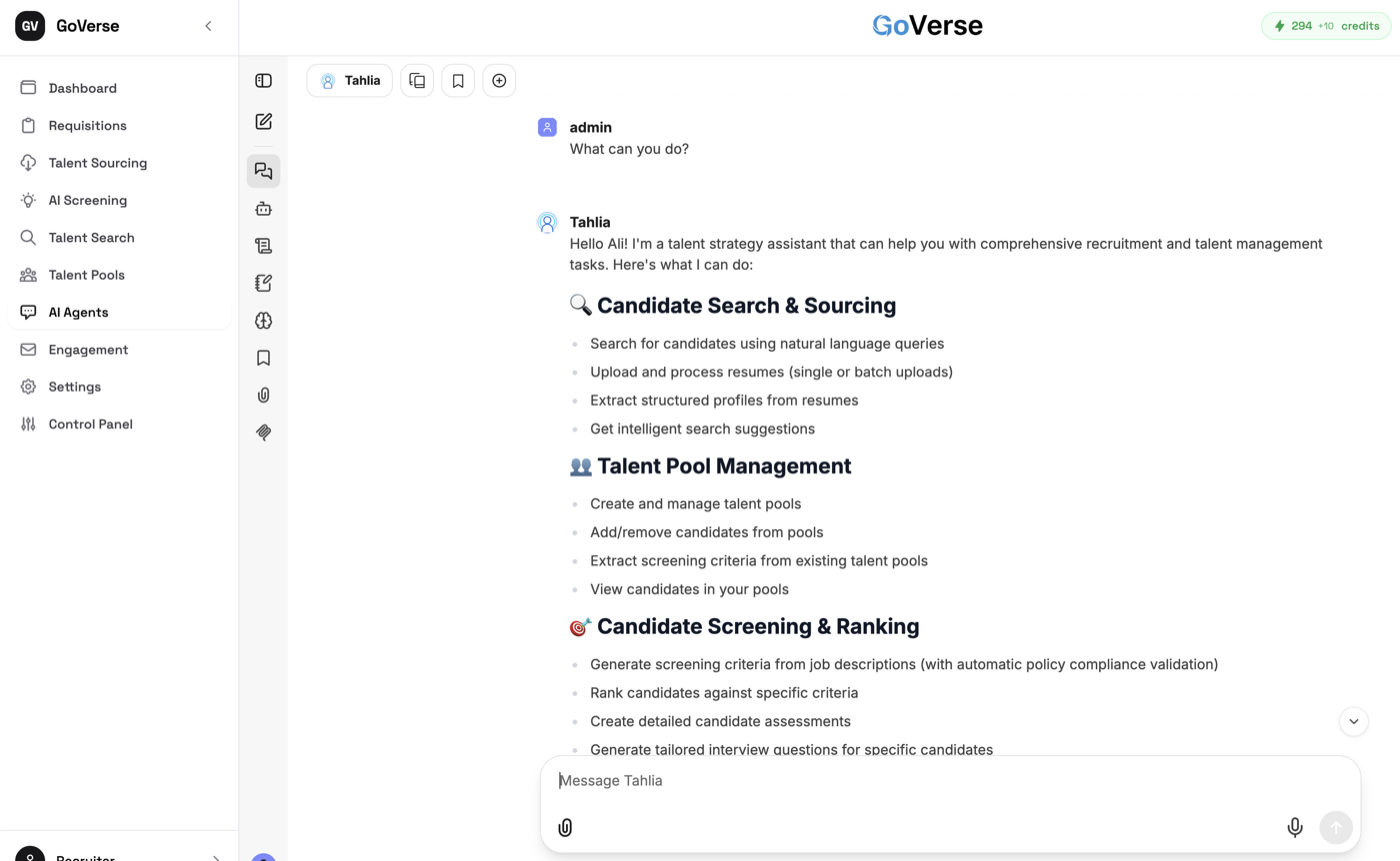
Ask an agent "What can you do?" and it lays out its skills across the recruiting workflow, candidate search and sourcing, talent pool management, and candidate screening and ranking, complete with match scores and reasoning.
Meet Tahlia, Your Strategic Talent Partner
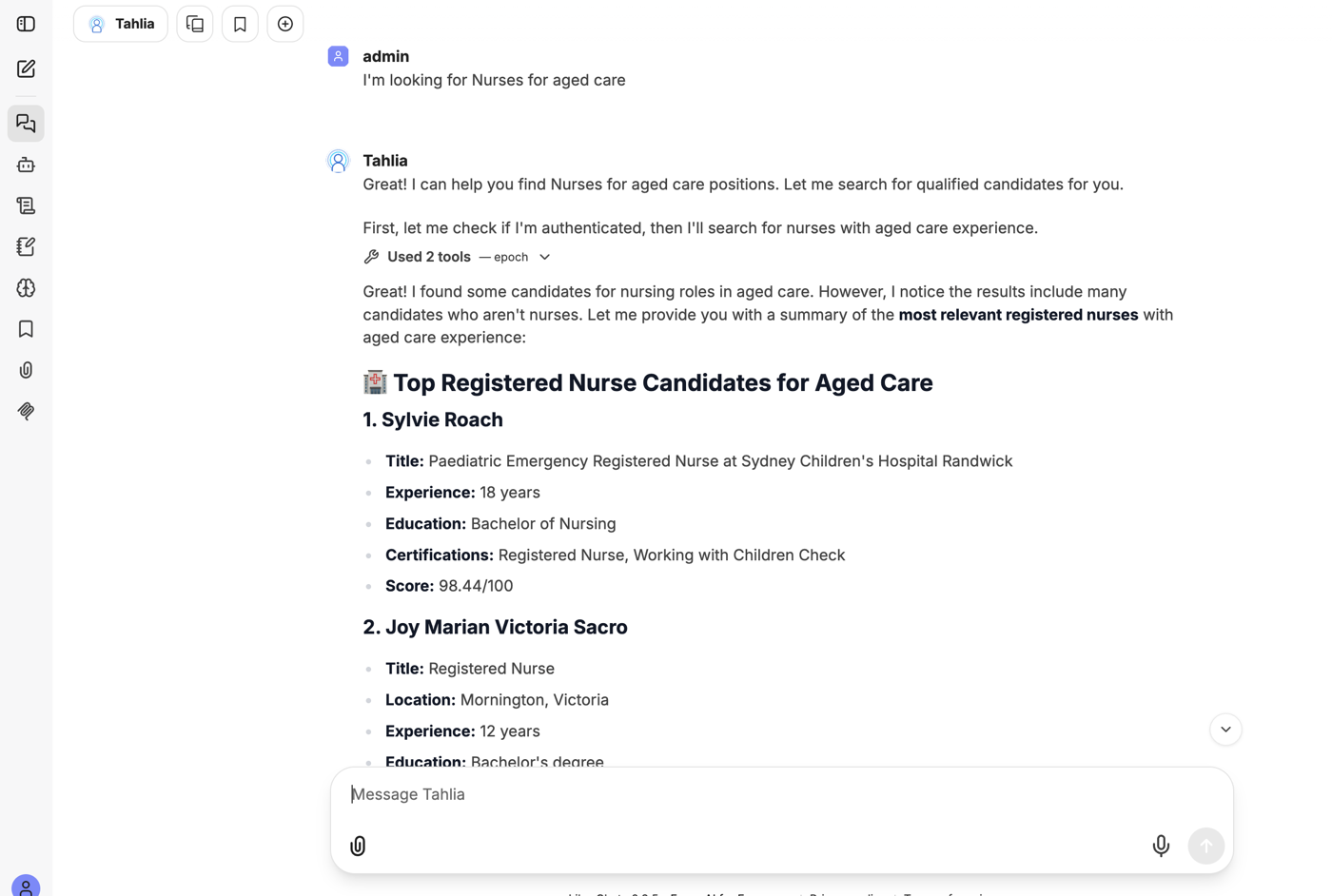
Every Premium account comes with Tahlia, a strategic talent-acquisition agent built for recruiters. Tahlia works conversationally: say "I'm looking for nurses for aged care," and she searches your talent data, filters to the genuinely relevant candidates, and returns a ranked shortlist, each with title, experience, certifications, and a match score. Refine iteratively ("only Melbourne," "exclude anyone we contacted this month") and she adjusts without losing the thread.
Because Tahlia keeps context, working with her feels less like operating software and more like briefing a capable colleague. She remembers what you asked, what she found, and what you wanted next.
Answers You Can Explore, Not Just Read
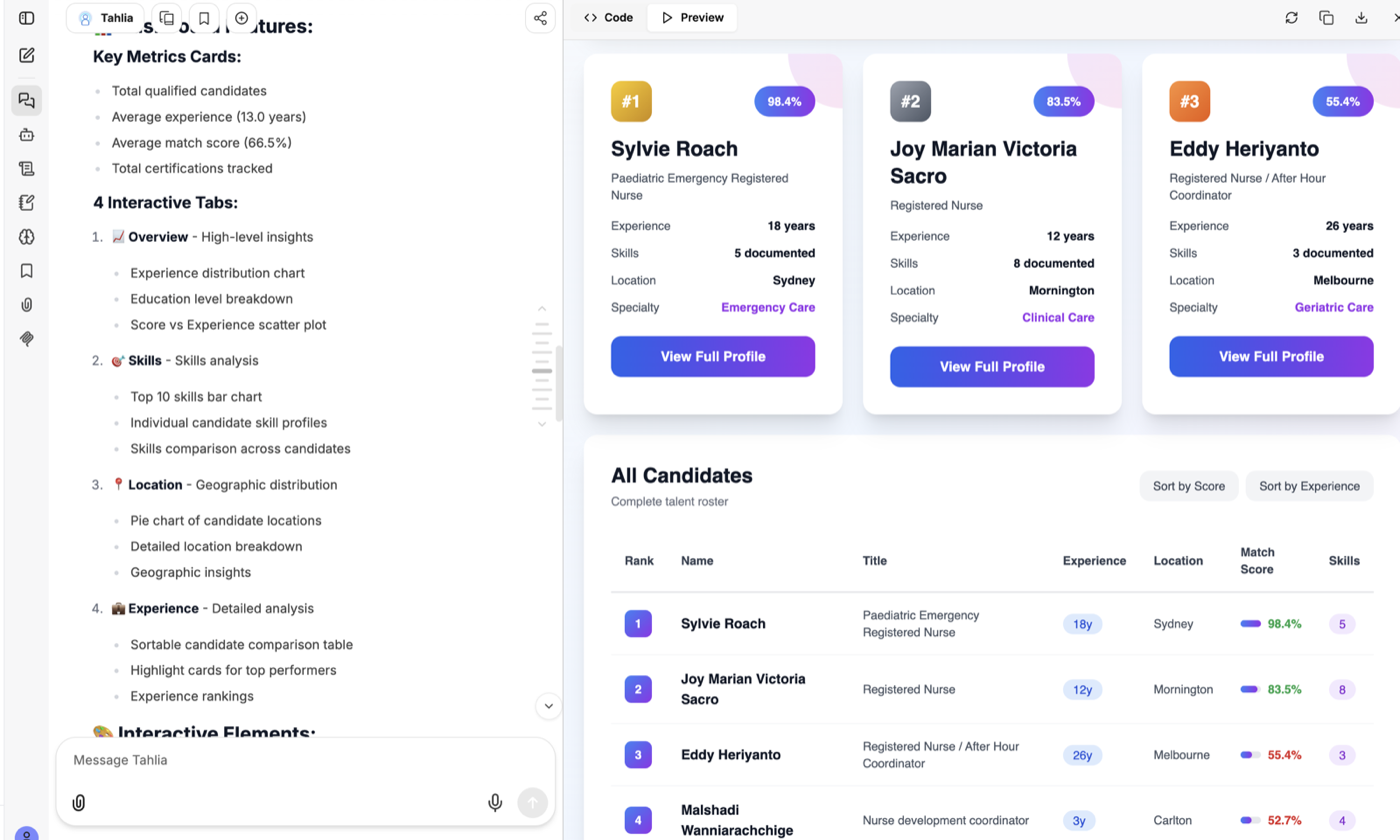
GoVerse Agents don't just return text. They can build interactive artifacts. Ask for a dashboard and the agent generates one on the spot: key-metric cards (total qualified candidates, average experience, average match score, certifications tracked) and charts you can page through by skills, location, and experience, with tabs to switch views and a toggle between the live preview and the underlying code. A shortlist becomes a briefing you can actually interrogate, in seconds.
Platinum: Build Your Own Agents and a Marketplace
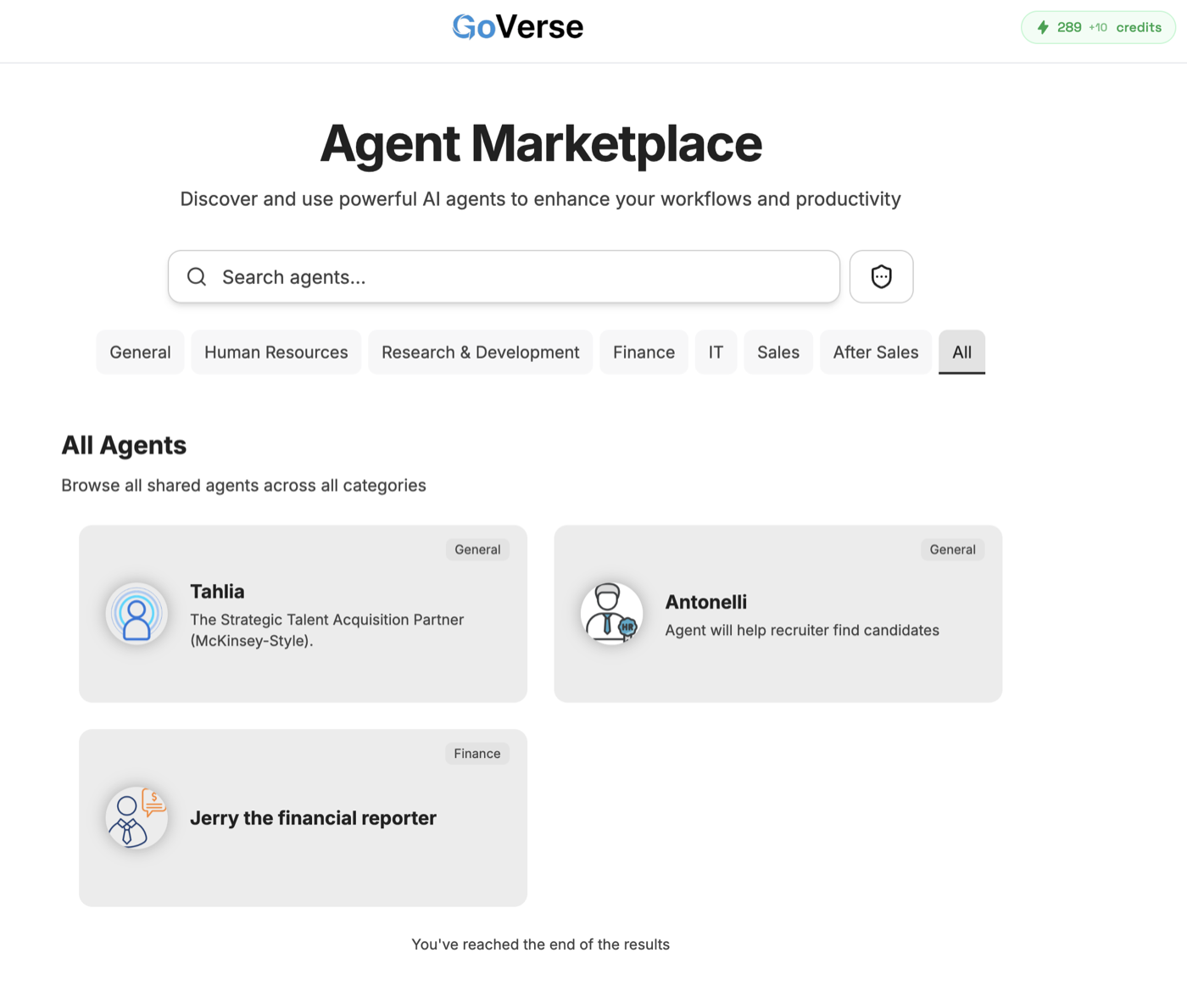
Platinum accounts let you create new agents, browse and use the Agent Marketplace, and build custom agents tailored to how your team works. The marketplace lets you discover shared assistants across categories (General, Human Resources, Finance, IT, Sales and more), such as Tahlia for talent acquisition, an agent that helps recruiters find candidates, or a financial-reporting specialist.
The agent builder puts you in control: give the agent a name, description and category, write plain-language instructions that shape its behaviour, choose the AI model it runs on, and switch on capabilities like Code Interpreter, Web Search, File Context, and Artifacts (the interactive outputs above). You can create a specialist for any repeatable job (sourcing for a hard-to-fill role, drafting outreach, or building weekly pipeline reports) and share it with your team.
Skills: Consistent Behaviour, Reused
Agents can draw on reusable Skills, packaged instruction sets for a specific task, such as a financial-reporting skill that tells an agent exactly how to pull and structure a report. Skills can be managed centrally and shared, so your agents behave consistently across the whole team instead of everyone reinventing the same prompt.
What This Means for Your Team
GoVerse Agents aren't here to replace recruiters. They remove the mechanical overhead that gets in the way of judgement and relationships. Searching talent, screening and ranking, comparing a shortlist, and pulling it all into a dashboard happen through conversation instead of clicking between screens. Premium teams get a capable partner in Tahlia from day one; Platinum teams go further, building a bench of specialist agents and sharing them through the marketplace.
Conversations use AI credits, so you always know what an interaction costs, and the work that used to take an afternoon takes a sentence.
The Friday-afternoon shortlist that started it all
Let me tell you about a recruiter I'll call Jordan. She is illustrative, a stand-in for the kind of person who first made agents click for us, not a specific client we can name. Jordan ran a specialist desk placing aged-care nurses, and her worst hour of the week was 4pm on Friday, when a hiring manager would email asking for "a few options" for a Monday interview panel.
Before agents, that email meant an hour of boolean searches, three browser tabs, a spreadsheet she copied names into by hand, and a growing suspicion she was missing someone good. She once told us she kept a sticky note on her monitor that read "did you check the pool from March?" because the March candidates were the ones she always forgot.
The first time she briefed Tahlia instead, the whole thing collapsed into a conversation. "I'm looking for nurses for aged care." A ranked shortlist came back with titles, experience, certifications, and match scores. "Only Melbourne." The list adjusted. "Exclude anyone we contacted this month." Adjusted again, without losing the thread. What had been an hour of clicking became four sentences and about ninety seconds. The sticky note came down.
From a List to a Briefing You Can Interrogate
Here is where it stopped being a faster search box for Jordan and started feeling like a teammate. She asked Tahlia to turn the shortlist into a dashboard, and the agent built one on the spot: metric cards for total qualified candidates, average experience, and average match score, plus charts she could page through by skills and location.
That mattered because the hiring manager's next question was never "who is on the list." It was "why these people, and what are we short on." With an interactive artifact in front of her, Jordan could answer in the meeting instead of promising to "look into it." The shortlist stopped being a static output and became something she and the manager explored together, in real time, while the decision was actually being made.
The human stake here is subtle but real. Recruiters are often treated as order-takers who fetch resumes. When Jordan walked into that room with a dashboard she could interrogate, the conversation shifted. She was advising, not fetching. As she put it in a paraphrase we share for illustration: "For the first time the hiring manager was asking my opinion, because I finally had the picture in front of me instead of buried in tabs."
The moment a team outgrows one agent
Tahlia covers a lot of ground on her own, and for most Premium teams she is enough for a long while. The teams that reach for Platinum tend to hit the same wall at the same time: they notice they are asking the same specialist question over and over, and phrasing it slightly differently every time.
One team we worked with kept rebuilding the same weekly pipeline report by hand-prompting an agent every Monday, each recruiter slightly differently, each report slightly inconsistent. The fix was not a bigger model. It was a custom agent with written instructions that produced the report the same way every week, plus a Skill that told any agent exactly how to structure it. Suddenly the Monday report was consistent across five recruiters, because they were no longer each reinventing the same prompt.
That is the quiet value of the Agent Marketplace and Skills. A single good prompt, discovered once by one recruiter, becomes shared behaviour for the whole team. The sourcing approach that works for a hard-to-fill role does not live in one person's head anymore. It lives in an agent anyone can call.
What We Tell Teams To Be Honest About
Agents are not magic, and we would rather set the expectation than have you discover it the hard way. Two things are worth saying plainly.
First, an agent is only as good as the instructions and context it is given. A custom agent with a vague description behaves vaguely. The teams that get real value spend an afternoon writing clear instructions and testing them, the same way they would brief a new hire. The builder makes that easy, but it does not do the thinking for you.
Second, conversations cost credits, and that is deliberate. It means an interaction has a visible price, which keeps usage honest and lets you plan. It also means the occasional exploratory question has a small cost attached. We think that trade is worth it, because the alternative, an opaque "unlimited" plan, usually hides the cost somewhere less pleasant. You should know what a piece of work cost, and with credits you do.
Why This Shape and Not Another
We could have built one giant do-everything assistant. We chose a bench of agents you can name, brief, and share instead, because that is how recruiting teams actually work. You do not hand every task to the same person. You have a sourcing specialist, a reporting person, someone who owns a particular desk. Agents mirror that. Tahlia is your strategic talent partner from day one on Premium. On Platinum, you build the rest of the team around her, and the marketplace means the best of what one team builds can be borrowed by the next.
The through-line, from Jordan's Friday shortlist to a five-person team's shared Monday report, is the same. The mechanical overhead that used to sit between a recruiter and their judgement moves into conversation, and the recruiter gets their attention back for the work that needs a person.
Meet GoVerse Agents
Premium comes with Tahlia, your strategic talent partner. Platinum adds custom agents and the Agent Marketplace. Search talent, screen candidates, and build dashboards, all through conversation.
Start free trial →