How our AI engagement system screens candidates by phone, and what happens after
Recruiters spend hours on the phone collecting information that candidates haven't provided in their applications. Missing data points lead to unfair rankings. Candidates who didn't mention their availability get scored lower than those who did. We built an AI engagement system that proactively fills those gaps, giving every candidate an equal opportunity.
The problem with incomplete candidate data
When candidates apply, their CVs contain varying levels of information. Some mention availability. Some don't. Some state salary expectations. Most don't. This creates an unfair ranking problem. Candidates with more complete information get evaluated more accurately, while others fall through the cracks simply because they didn't volunteer certain details.
Manual phone screening to fill these gaps is the most time-consuming part of the funnel. A recruiter with 50 applicants spends days making calls to collect missing information. Meanwhile, the best candidates get snapped up.
GoVoice: proactive data collection for fair ranking
GoVoice is our AI voice agent. It proactively reaches out to candidates to collect whatever information is needed for fair evaluation. When a recruiter clicks "Screen" on a candidate card, the system:
- Calls the candidate's phone (a real call from a real number, not a chatbot link)
- Conducts a natural conversation (introduces itself, explains it's calling about the role, asks if they have a couple of minutes)
- Collects configurable data points (whatever the role requires for fair ranking, configured per requisition)
- Respects boundaries (if the candidate says they're busy or not interested, it thanks them and hangs up)
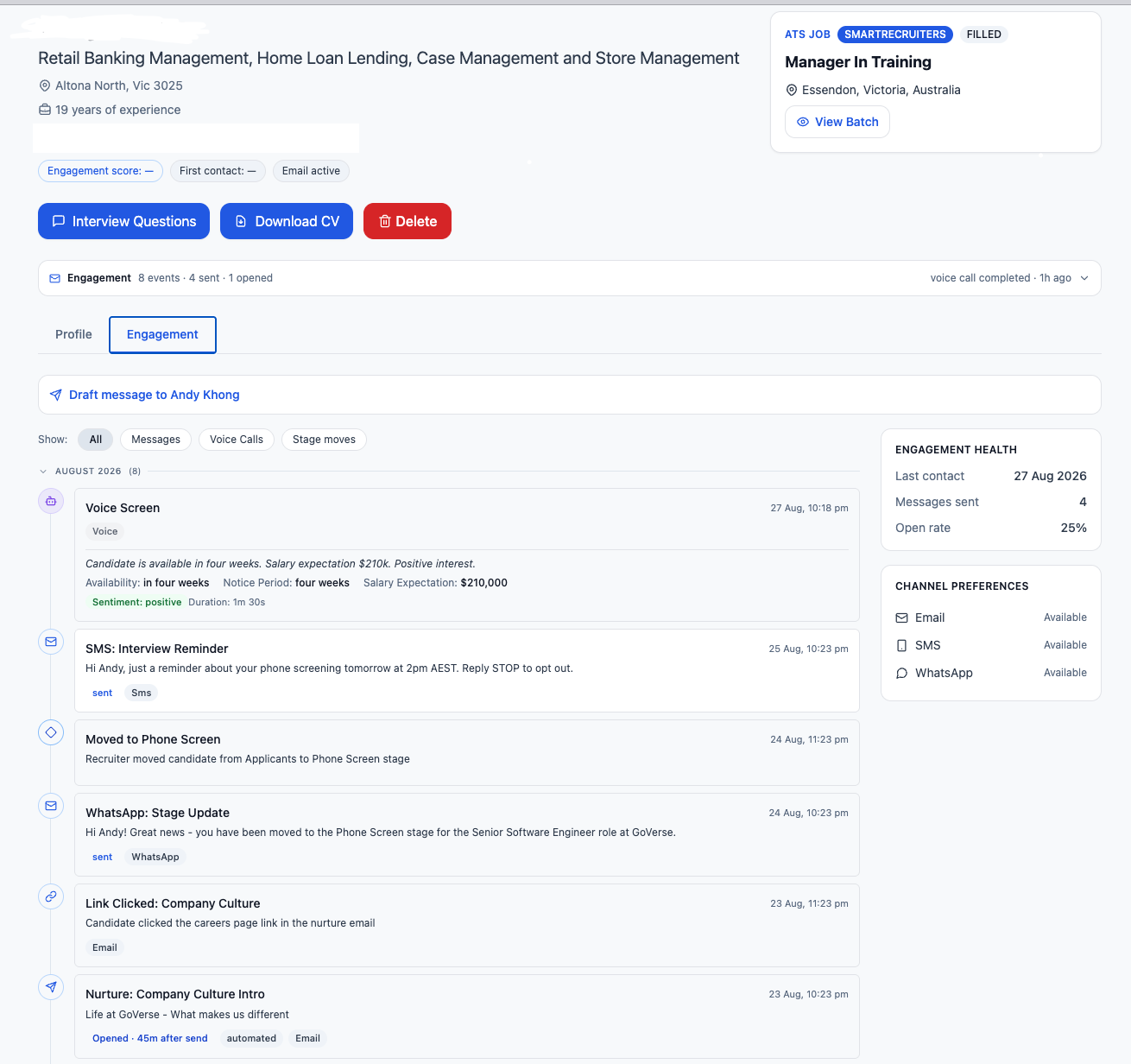
- Reports back (structured answers, sentiment analysis, and a text summary land on the candidate profile immediately)
This is a fairness measure. Candidates who didn't include certain information in their CV get the same opportunity as those who did. Everyone is ranked on complete, comparable data.
What makes the voice natural
GoVoice isn't an IVR system or a robocall. It uses real-time speech-to-text, a language model for conversation, and text-to-speech to produce natural, flowing dialogue. It handles interruptions, pauses, um's, and "sorry, what was that?" gracefully.
If a candidate says "I'm at $180 but I'd consider $160 for the right role," the agent captures that nuance. It's not filling in a form. It's having a conversation and extracting the signal.
Beyond voice: multi-channel engagement
The voice screen is one touchpoint in a broader engagement system. Every candidate has a unified timeline showing all interactions across channels:
- Email (AI-generated stage notifications, interview prep material, offer letters)
- SMS (Interview reminders, schedule confirmations, quick updates)
- WhatsApp (Rich conversations, document collection, two-way messaging)
- Voice (AI screening calls with full transcript and scoring)
Automated nurture sequences
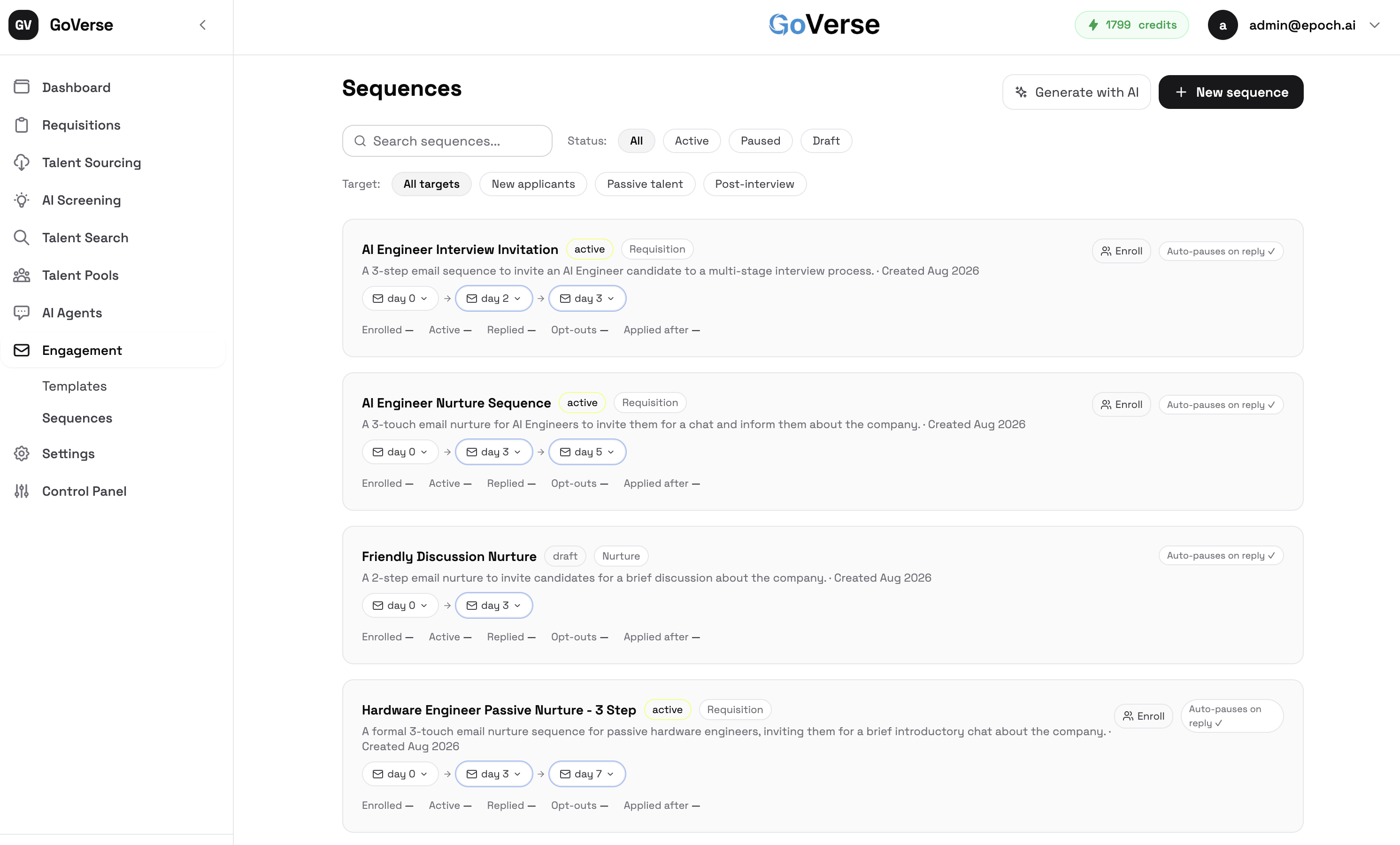
Not every candidate is ready to move forward today. Nurture sequences keep them warm:
- Pipeline sequences (automatic comms when candidates move between stages)
- Talent pool nurture (monthly touchpoints for silver-medal candidates: "We have a new opening that matches your profile...")
- Re-engagement (wake up candidates who went cold 3-6 months ago)
Smart frequency guards prevent over-communication. Candidates can set preferences. The system stops all sequences instantly if someone replies or opts out.
Event-driven workflows
The engagement system is event-driven. When something happens in the pipeline, the right communication fires automatically:
- Application received → confirmation email + schedule AI screening call for next day
- Moved to Phone Screen stage → send WhatsApp with recruiter intro
- Interview scheduled → SMS reminder 24h before
- No response after 5 days → re-engage via preferred channel
- Rejected → respectful notification + add to talent pool nurture
Recruiters configure the workflows once. Every candidate gets a consistent, timely experience regardless of how busy the team is.
Everything in one timeline
The engagement tab on each candidate profile shows every interaction chronologically: emails sent and opened, SMS delivered, WhatsApp messages, voice screening results with full transcript, stage moves, and system events. Recruiters can filter by channel, collapse by month, and click to expand any item.
No more "did anyone follow up with this person?" The answer is always visible.
What this means for recruiters
With AI engagement, a single recruiter can manage 10× the candidate volume with better candidate experience:
- Screen 50 candidates in a morning (AI calls them while you work on other things)
- Zero candidates lost to silence (automated sequences ensure everyone hears back)
- Candidate experience scores go up (timely, personalised communication at every stage)
- Complete audit trail (every communication logged, compliant, and searchable)
Try it
The AI engagement system including voice screening is available on all GoVerse paid plans (Premium and above, from $99.99/seat/month). Start a free trial and screen your first candidate by phone within the hour.
The moment a recruiter stopped believing it was a robocall
The first time I demoed GoVoice to a recruiter running high-volume retail hiring, she folded her arms and said, "Candidates hang up on robots. This will tank my response rate." Fair scepticism. So we did the honest thing: I asked her to give me one of her real applicants who had gone quiet, and we placed the call live while she listened on speaker.
The candidate picked up, the agent introduced itself and said it was calling about the role she had applied for, and asked if she had two minutes. The candidate said she was walking to the bus but could talk. The agent asked about her availability for shifts, whether she had a current food-handling certificate, and how soon she could start. When the candidate said "I finish my current contract in three weeks but could do weekends before then," the agent captured that exactly, not as a yes or no but as the nuance it was. The recruiter's arms unfolded about halfway through. Her comment afterwards: "That's better than the message I would have left on her voicemail."
Before and after, with the numbers that mattered to that team
That team's before picture was familiar. A recruiter with roughly 50 applicants per role would spend two to three days calling to collect availability, certificate status, and start dates. Most calls went to voicemail. A lot of candidates never got called at all because the recruiter ran out of hours, and those candidates were scored on incomplete data, which meant some of them were quietly ranked lower purely because nobody had reached them.
After turning on voice screening, the same 50 applicants were called the day after they applied, while the recruiter did other work. Roughly the same proportion answered as would have answered a human call, and the ones who did not answer were retried at a different time of day automatically. The change she pointed to was not just speed. It was that every candidate now had the same set of data points on their profile, so the ranking was comparing like with like. The candidate who forgot to mention her availability on her CV was no longer punished for it.
What the transcript adds that a form never did
The structured answers are useful, but recruiters told me the full transcript and the sentiment read were what changed how they used it. A candidate can technically answer "yes, I'm available weekends" while sounding hesitant about it, and the transcript preserves that. One recruiter caught a candidate who gave all the right answers but clearly did not want the role, and she chose not to waste an interview slot on them. That is a judgement she could only make because the conversation was there to read.
What confused people at first
The biggest point of confusion was the difference between the voice screen and the nurture sequences. A few users assumed turning on engagement meant candidates would immediately get bombarded across email, SMS, and WhatsApp all at once. That is not how it works, and the frequency guards exist precisely to prevent it, but the mental model was not obvious from the settings screen. We now walk people through it as two separate ideas: the voice screen is a single, deliberate call to collect data; the sequences are the slower drip that keeps candidates informed between stages.
The second confusion was about configuration. People expected to configure the exact script the agent reads. You do not script it word for word. You configure the data points you need collected per requisition, and the agent has the conversation naturally around those. A couple of users found that unsettling at first because they wanted control over the wording. Once they heard a few real calls, most preferred it, because a scripted call is exactly the robocall they were afraid of.
One thing we still want to improve
Accents and noisy environments are where we still lose some quality. A candidate calling from a busy shop floor with a strong regional accent will occasionally have an answer captured less cleanly than someone in a quiet room, and the recruiter has to fall back to the transcript to confirm. It is not frequent, but it happens, and we would rather be upfront about it than pretend the speech recognition is perfect. Improving reliability in poor audio conditions is an active piece of work, and until it is where we want it, the full transcript is always there as the backstop.
If you are trialling this, my advice is to start with a handful of your own quiet candidates who have gone cold, listen to the calls yourself, and only then turn it loose on a full batch. Hearing it work on people you know is what turns scepticism into use.